#Visionontv is a grassroots media project that aims to provide an alternative to mainstream media by creating and distributing independent video content. The project has been running for over ten years and is based on the principles of openness, collaboration, and decentralization. It uses #FOSS open-source software and decentralized platforms to create and distribute activist video content. One of the key features of the project is its participation in the Open Media Network (#OMN), a decentralized network of media sites that share content and promote independent media that is not controlled by any single entity. The project emphasizes the importance of grassroots community-driven media, where people and groups can create and share their own content.
Tag: visionontv
The world walks right past us looking the other way and takes the big bundle of bills from capitalism.
OK, had to close then open new accounts on #visionontv #peertube because of #spam, the spam is starting agen – there is an update that allows you to put new accounts on ask/moderation, we need to upgrade at some point to get this.
Interesting this is exactly the way our ten-year-old #OMN project handles flows as is the “new” moderation in #bluesky… if we don’t manage to go to the world, the world come to us… well more like the world walks right past us looking the other way and takes the big bundle of bills from capitalism.
This is normal, we are still doing needed work, but better would be good to 🙂
They all share #4opens #openweb tech, so this is a win.
Where they differ is in the “culture” they come from and push.
#bluesky comes from surveillance capitalism, it’s from the #dotcons and has meany of the same assumptions, just “better”.
#Nostr comes from the #encryptionists and #bitcoin bro crew and suffers from being from this mess.
#activertypub is #openweb native and comes from the #4opens traditions the whole software world is actually built on.
The #KISS path is to simply bridge them all and let them cooperate, as they are all a part of the #openweb family.
The more complex and messy path is that some of them might not want to do this… OK now we get to the part where piss is likely signal rather than noise. Let’s draw a line, (a date is good) if they don’t bridge, we let loose the pee, liquid trickling in will short out their servers.
Ending thought:
For a lot of our #fashernistas in our spaces, things only matter if they come from #mainstreaming this is obviously crap blinded behaver – but it’s hard to communicate why, likely they can’t see me 😉
PS. I liked that joke.

A draft funding application – OGB
Requesting funding for the Open Governance Body (#OGB) project. Which is being developed by the Open Media Network (#OMN). The OMN is a collective that builds and hosts #4opens standards-based socio-political software. Our mission is to provide communities with the tools they need to organize, communicate, and make decisions.
The #OGB project is a grassroots initiative that seeks to empower communities by giving them a stronger voice in decision-making. We believe that traditional social coding projects that are based on a top-down approach to power are not effective. Our approach is different. We are developing a bottom-up solution that is based on the principles of sharing power and collective decision-making.
Our team has years of experience in grassroots social tech projects. We have been directly involved with #UnderCurrents, #indymedia, #VisionOnTV, #LondonBoating, among others, and have a firm grasp of what does and does not work within organizing both social and technological communities. We have also worked on UN and World Bank projects in West Africa and have decided to manage them through community/scrum, rather than formal methods.
We are seeking funding in the amount of $50,000. This funding will be used to pay four people to work on the project at a fixed rate of ten thousand euros for 9-12 months of work. The bulk of the work will be programming and implementation details. The remaining ten thousand will be used for servers, expenses, outreach work, extensive testing, and basic project upkeep.
A Look at Existing Projects
It is important to note that foundation funding agendas can have a negative effect on the agendas of #openweb projects. A brief look at some existing projects highlights this issue. For example, decidim.org, which is an NGO process similar to loomio.org, Formal processes can be a bad tool for “herding cats” in social challenge or activist groups. And has been imposed numerous times in activism but has always failed.
After reviewing loomio.org, it is clear that the same ideas and workflows were pushed onto #climatecamp, #indymedia, and #occupy. In the first two cases, it ossified the projects, and in the last case, it was a mess. The #processgeeks behind these projects have not changed, and their projects are a bad fit for life and a terrible fit for the fediverse and activism. However, they may work for some NGOs and more formal cooperative organizing.
It is important to note the differences between formal and informal governance structures. Both use “consensus,” but the Open Governance Body is more like a do-ocracy than a formal governance structure.
- Sortition: https://en.wikipedia.org/wiki/Sortition
- Statements of Support: https://unite.openworlds.info/Open-Media-Network/openwegovernancebody/wiki/Statements-of-support
- Mastodon Project Governance: https://discourse.joinmastodon.org/t/mastodon-project-governance/215/50
- Fediverse Gitlab Issues: https://gitlab.com/fediverse/fediverse.gitlab.io/-/issues/4
- Sociocracy 3.0: https://sociocracy30.org/
- Enspiral: https://www.enspiral.com/
- Ukuvota.world: https://ukuvota.world/#/
The visionontv project has been runing for over ten years
The #visionontv project has been running for over ten years. It is a grassroots media project that aims to provide an alternative to mainstream media by creating and distributing independent video content. It is based on the principles of openness, collaboration, and decentralization. The project uses open-source software and decentralized platforms to create and distribute activist video content. Emphasizes the importance of grassroots community-driven media, where individuals and groups can create and share their own content.
One of the key features of the #visionontv project is its is a part of the Open Media Network (OMN), a decentralized network of media sites that share content and promote independent media that is not controlled by any single entity.
What is visionontv

The #visionontv project is a part of the Open Media Network (#OMN), which is a grassroots initiative to create a decentralized and federated network of media platforms that share common values and principles. Create an internet distribution channel for alternative news, covering topics such as social movements, environmental issues, human rights and more. The project also provides video production education and training for activists and citizen journalists. The visionontv grew from undercurrents and was co-founded by Hamish Campbell, a filmmaker and activist.
History of copyleft activist grassroots video distribution
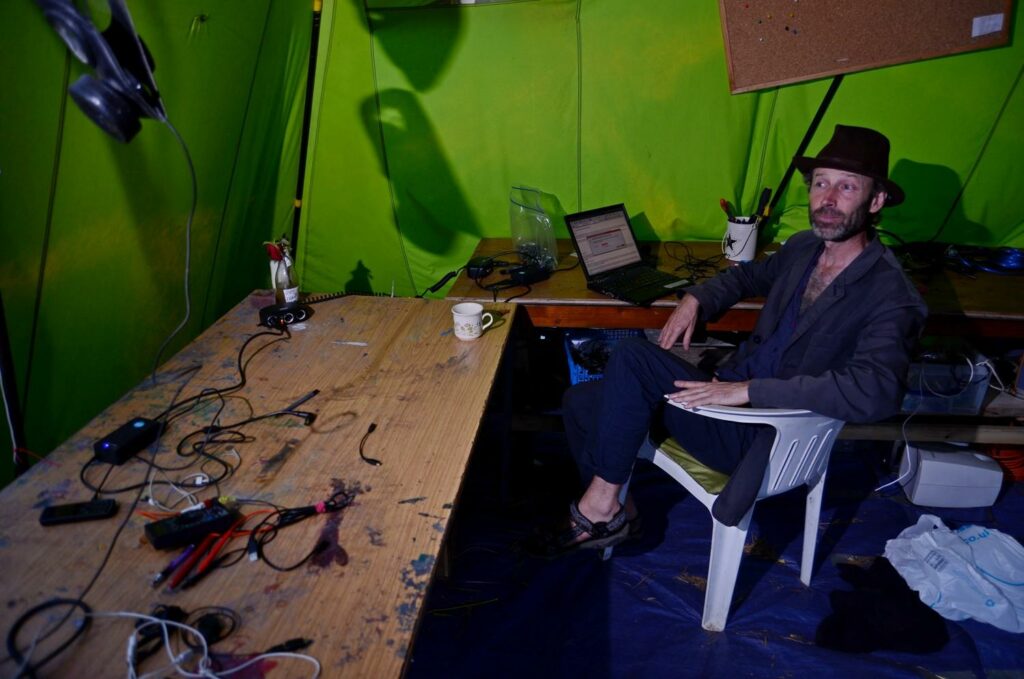
Hamish Campbell, the founder of #VisiononTV, began his journey into copyleft video through his project called #RoughCuts. In a recent interview, Campbell shared how RoughCuts started as one of the first copyleft video projects that encoded activist video in MPEG-1 format, an early standard format for video. He would burn CDs with an hour of different films and create a user interface using HTML to make it easy for people to watch them and screen them from their computers.
The CDs were sold for five pounds each, the project was designed to be a sustainable #DIY media distribution platform. People were encouraged to buy the CD, copy it, and give it away for free, and the revenue generated from the CD sales would help fund national screening tours, pay for travel expenses and equipment repair.
As the technology of the web advanced, people could watch videos online at a reasonable quality, which made the CDs obsolete. Hamish took a break from RoughCuts until the technology caught up a year or two later, and he started VisiononTV, a webTV project distribution platform for on-the-ground screenings. People could watch the videos on the web, but the primary focus was on taking the content offline and showing it on big screens to an activist community audience in the same room.
Hamish Campbell’s RoughCuts project was a pioneering effort in the field of copyleft video, which paved the way for his later project, VisiononTV. His approach of creating sustainable DIY media distribution platforms continues to inspire and influence media activists around the world.
An interview with Hamish Campbell on grassroots media and tech
Interviewer: Can you tell us about your project #RoughCuts and how it started?
Hamish Campbell: Before I did #VisiononTV, I started a project called RoughCuts, which was offline copyleft video. It was one of the first copyleft projects with video, encode in the MPEG-1 an early standard format for video, about VHS quality video. You could fit an hour on a cheap CD. I would burn these CDs with different films, and an interface to the front of it using an HTML page, so you put the CD in your computer, and this web page would pop up with a list of all the films with a bit of information and a link to play the film. Then I would copy these in a CD burner. I’d go around the country doing screenings and I would sell the CDs for five pounds if people wonted to support the project.
Interviewer: How did you fund national screening tours for Rough Cuts?
Hamish Campbell: I funded national screening tours by selling these CDs, which were available for free if people wanted to copy them. So, I said, buy the CD, then go home, and copy it and give it all to your friends. It was a take-it-away-and-distribute-it-yourself project. It was sustainable DIY media distribution, so the person who was doing it could be sustained and could actually make a little bit of money to travel around and pay the expenses, repair cameras, etc.
Interviewer: How did the technology change of the web impact RoughCuts?
Hamish Campbell: The technology of the internet moved on, so people actually could put video on the web and watch it on the online in reasonable quality. So then, why buy a CD? Why have a physical medium? It became an obsolete project. So then I kind of stopped doing that for a while, but then a year or two later, the web technology caught up, and it was really easy to do web video. So I thought, let’s do a webTV project distribution project for on the ground screenings, so people can watch on the web, but what it’s really about is taking it off the web and showing it on a big screen to a bunch of people in the same room. That’s how #VisiononTV came about.
Hamish Campbell is an activist and filmmaker
Hamish Campbell is an activist and filmmaker who gained attention for capturing footage of a police raid on the Independent Media Center in 2001. His footage was used in court and led to several police officers being disciplined and sacked. Campbell continues to work in media activism, founding the group #VisionOnTV, which aims to create a more horizontal media that challenges traditional gatekeepers. He believes that corporate media will continue to exist, but that we can build a different kind of media that is more open and democratic. Campbell is less interested in traditional media, and more focused on creating a new kind of media that is based on a more #4opens collaborative, decentralized model.
What do you mean by “mainstreaming”
Q. what do you mean by “mainstreaming”.
A. we all worship the #deathcult (neo-liberalism) in polatics, economics, most of the food we eat, our jobs and social lives are all mediated/mostly created by this invisible world-view. In progressive terms #mainstreaming is pushing this agender to build carriears and social structures to further the personal #stupidindividualism created by the #deathcult we live in. This is a circle that is going to kill and displace billions of people over the next 100 years from #climatechaos and the social feedback loop of political #fascism
#stupidindividualism is created by the social disintegration of the last 40 years of neo-liberalism, fascism is an outcome of this.
Examples from the UK groups @NovaraMedia while producing fab content its all distributed through the #dotcons and in the end they aspire to be the new @guardian to take the role of #traditionalmedia This is fair anufe but the wider “we” need to balance this with #grassroots media which is a non #mainstreaming mission.
Most #NGO agrenders are #mainstreaming this is an easy to see view.
I played a role in training thousands of grassroots “journalists” over the last 25 years at #undercurrents, #indymedia, #visionontv and now #OMN the majority that are still creating media went onto build there carriears in the mainstream and #NGO sectors few stayed in non #mainstreaming production missions. Cant blame them for this, though no alts were sustained from this which was why we did the training.
In each case grassroots/alt structures were devoured by the #deathcult pushing the need for mainstreaming survival – cant blame people for this.
BUT we need a working alternative if we are going to change the world that does not kill and displace billions of people over the next 100 years #XR
learning for expirence the #OMN is a political/tech tool to mediate this issue.
The #openweb is a space for both progressives and reactionary groups
One uncomfortable thing we need to address, calmly and constructively, is this: for the last decade, the right has been better at cooperating around #openweb media than the left.
This isn’t because the right has better politics. It’s because they’ve been more pragmatic about infrastructure. While much of the left argued endlessly about identity, fashion, theory, tone, and purity, right-wing and reactionary groups quietly built linking ecosystems: shared blogs, cross-posting networks, video hubs, newsletters, forums, and self-hosted media that reinforced each other. They understood, often instinctively, that control of distribution matters more than rhetorical perfection.
By contrast, the left has been worse than useless on some of the basics. Something as simple as linking between radical media projects has often failed. Projects compete for attention, split over minor differences, or collapse into internal conflict. Even when the politics align, cooperation doesn’t follow. The result? Fragmentation without any resilience.
Ironically, the few left-wing media projects that have succeeded at scale largely did so by abandoning alternative tech altogether. They built their audiences and careers inside the #dotcons – Twitter/X, YouTube, Facebook, Substack – accepting algorithmic dependency as the cost of survival. That choice brought reach, but at the price of autonomy, long-term stability, solidarity and real political leverage.
This isn’t a moral judgement – it’s a structural observation. Platforms reward individual brands, they block collective ecosystems. Once inside that logic, cooperation becomes optional and is often discouraged.
Where progressives have quietly seceded is not primarily in party politics or campaigning, but in lifestyle and cultural subcultures. This is where the #fediverse, #Mastodon, and other #openweb tools first took root. These spaces were driven by values – privacy, autonomy, care, consent – rather than reach or growth.
For a long time, that made them feel “apolitical” in the narrow sense. But in reality, they were deeply political, just not aligned with electoral or media spectacle cycles. They were building infrastructure for different kinds of social relations, not greed feed messaging machines.
Alongside this, we’re seeing tools being used more explicitly for radical and progressive agendas. Projects like #VisionOnTV and #IndymediaBack are reconnecting media with movement. Spaces like #Kolektiva bring an explicitly #fashionista anarchist politics into federated infrastructure. And frameworks like #OMN (Open Media Network) focus on shared process, trust, and governance rather than branding or growth.
This is important because as #mainstreaming accelerates and trust in the #dotcons continues to erode, both progressive and reactionary groups move further into the #openweb. The question is not whether this will happen, it’s how we shape the culture and norms of these spaces.
The right tends to treat tech instrumentally: as a tool for mobilisation, influence, and power accumulation. That can make them effective in the short term, but it often leads to centralisation, cults of personality, and brittle structures that fracture under pressure.
The left, when it’s at its best, treats tech as part of a broader social ecology: something that should support care, plurality, mutual aid, and collective agency. But when the left fails, it fails by refusing to build — mistaking critique for action, and purity for strategy.
The #openweb doesn’t automatically belong to anyone. It’s a terrain of struggle. If progressives don’t show up, cooperate, and do the boring work of linking, hosting, moderating, and sustaining infrastructure, others will fill that vacuum. This is why now is the time to make your space in this network and be heard.
Not by abandoning existing networks overnight, but by practicing a #stepback: one foot in, one foot out. Staying connected where people are, while actively building and strengthening open alternatives. Helping others take that step, rather than shaming them for not already being there.
If we could build #dotcons social media, we can build #openweb social infrastructure. If we could centralise power, we can federate it. The #openweb path is not a retreat, it’s a return to shared ownership, shared memory, and shared responsibility. And it’s long past time the left took it seriously again.
More here: https://activism.openworlds.info (this link is now offline due to lack of support)

Cat videos – A “shadow ban” experiment on youtube
Just finished a cat video, it’s an experiment for #YouTube. We have over 7000 subscribers and over 5 million video views on our legacy #visionontv account Our viewing numbers have been dropping over the last few years, and now we get very few views, likely do to do with the activists content not being “ad friendly”. Have recently tried making fluffy content, very few views, so let’s try cats 😉
Am curious if the “algorithm” will pick it up or not. If it does pick up will it feed views onto the other videos on the account, with the suggestions etc.
Pushed it out quite hard on #failbook #twitter and #mastodon, but it did not pickup views on youtube (37 views in 15 hours) which suggests that the visionontv account is “shadowbanned” not surprising I suppose, will try pushing the video on cat forums to test how strong the “ban” is.
You can find much more interesting (but not as cute) videos on http://visionon.tv
Looking at the tech and organising of UK alt grassroots media
How meany sites link to another alt/grassroots media sits. From this list of 38 UK sites, only 2 link to another site.
Many people find it hard to understand the underlining understandings that push projects based on flow and linking, such as #OMN and #openweb. Here is a short list of activism projects.
Silo
Is a place for holding/hoarding closed data – this is used by the #dotcons to extract funding from “free users” when mainstream/alt silo projects finish, as 99.9% do, the data varnishes and is lost, and in this the effectiveness of any alt building is diminished. Silos do not use open licensing for content re-use. Just about every alt/grassroots media project is a silo. It’s about capturing data. It’s obvious that this is a unthought through issue of “churning”
Portal
It is an idea that you can be the big one, all the small fashionista websites aspire to be the big one and by doing this they are working to the logic of the #dotcon and working against the logic of the openweb. They are building a project to lock their users into their project. Portal and silo are overlapping (but different) ideas for building web projects. In the mainstream, Apple is a prime example of this working. In the alt/grassroots, almost all alt/grassroots media projects are portals. It’s about capturing users, just as silos are about capturing data. For a left wing group this looks much like “recreating the Soviet Union” the one party to rule the state.
Dotcons
Are for-profit data silos in the old days working as portals, more recently they are building out siloed networks as a pseudo networked portal. It’s both sad and bad that many alt media projects unthinkingly aspire to be #dotcons
Link
It is where ALL the value is, on the open web. Without links, content has NO VALUE. This is an obvious statement, its hard to understand the lack of understanding around this simple thing.
RSS
Is a grassroots web standard that is still at the base of many of the #dotcons world but is being pushed into the background of the #openweb by building silos/portals in the grassroots/alt. RSS is like an open LINK with added data, thus adds value to the web. Its a powerful open tool that we still have. An API is like a geek control freak superpower of RSS – the problem is in the complexity/control freak bit…
Geek
A subculture that is control/obscurity and more recently technical solutions to trust (wraparound right) this has always been a closing force on open projects. This helped to strangle the original successful alt/grassroots media projects and is pushing for the shrinking of the open web.
Fashionista
The unthinking desire for new/innovation/conformity. A wider subculture that churns the growth of alt/grassroots so little can grow beyond seedlings.
NGO
Are greedy dispoling of resources, both human and money. The liberals that use bureaucratic funding to push out the geek/fashernista agendas over alt/grassroots projects. These are uneasy friends and clear (invisible) enemies.
Network
It is both a technical thing of wires and frequency and an understanding of mutual aid and of “diversity of strategy”. It’s native to the openweb and should be at the base of any alt/grassroots media project. In the closed #dotcons the widespread use of A/B testing is a pail controlled shadow of this.
4opens
Wikipedia is an example of this. It’s basic stuff, open source project stuff. LINK
Looking at the tech and organising of UK alt/grassroots media. Do sites link to other alt-media projects? Do they support/display openweb standards (RSS)
First DRAFT (please message me with corrections/info)
the canary
Has a RSS feed, regular updates, copyright group silo, it has no outside linking
Reelnews
UPDATE: site back online, no visible RSS but can find a hidden one. It’s likely copyright and a silo.
(Their website is hacked/down, so posted the #failbook link used to have RSS and regular updates. Anyone know what’s happening? Update they hope the site is back online soon.)
Real Media
UPDATE: website back online copyright, no visible RSS feed, but you can find ones. It’s a bit of an aggregator but has been suffering from poor spam control. It’s pretty much a portal/silo – but could be more.
(They used to have an interesting website for the tec used, but it ended up being just a silo, they look like they are rebooting? Maybe a another silo? We shall see.)
Update they are rebooting as a linking site, let’s hope it’s not a silo.
Novaramedia
Has regular good content, RSS, they are a product of the #dotcons social media wave and good at it. Copyright/CC is not stated. The site is a silo with no outside linking
Counterfire
No RSS feed, starting to look a bit “old left” regular updates, no copyright/CC notice. A silo with no external links
The Bristol Cable – Bristol
No visible RSS feed, it kinda probably tries to obey the #4opens, maybe. It’s a WP blog site, in this it’s a media silo with no external links.
Port Talbot Magnet
http://www.porttalbotmagnet.com/
No visible RSS feed, it mostly fails the #4opens due to copyright, data and organising. It’s a WP blog site, in this it’s a media silo with few if any external links.
New Internationalist – based in Oxford
Has RSS feeds, it kinda passes the #4opens using a CC licence for its content. It links to the #visionOntv project.
The Ferret – Scotland, based in Edinburgh
Looks like the old media transitioning to the new media. No visible RSS feed or copyright/CC notice. Is trying to be “open process” looks like a WP site.
Strike! – based in London
Looks like an archive of a print mag? Has an RSS feed 🙂
Positive News – based in London
Dated looking site, hard to read, no RSS feed and a copyright notice. A silo.
Slaney Street – Birmingham
Did not load
Manchester Mule – Manchester
Has RSS feed but last article end of 2015 so not an active site. Probably for fills the #4opens.
Co-operative News – based in Manchester
Nasty looking site and no RSS, copyrighted, it’s a silo
Ethical Consumer
http://www.ethicalconsumer.org/
No RSS, copy rightish, old looking site.
Marlborough News Online
http://www.marlboroughnewsonline.co.uk/
no RSS, copyright
West Highland Free Press
No RSS, copyright, it’s a silo.
Star and Cresent – based in Portsmouth
http://www.starandcrescent.org.uk/
No RSS, no copyright notice? It’s a silo.
Morning Star – based in London
https://www.morningstaronline.co.uk/
Has an RSS feed but its empty, copyright, silo.
Cambria Publishing Co-operative
http://www.cambriapublishing.org.uk/
Publishes paper books?
Zed Books – London
paper books and online reading lists, no RSS I can see.
Sheffield Live!
Copyright, has an RSS feed, looks bureaucratic open.
Blake House – based in London
No RSS, fashionable calling card website without content, probably copyright?
Media Co-op
Calling card website without content, no RSS, likely copyright.
Ignite Creative – based in Oxford
Calling card website without content, no RSS, copyright.
Shedlight Productions – based in Southampton
http://www.shedlightproductions.co.uk/
Calling card website without content, no RSS, copyright.
Steel City Film and Media Co-op – based in Sheffield
https://www.facebook.com/SteelCityFAM
it’s a #failbook page, maybe open?
Trafford Media & Communications – based in Manchester
(mostly a printer, but also do film production)
Calling card, no site.
The Community Channel
The granddaddy of NGO media, no RSS feed, likely copyright silo.
Jammu Kashmir TV
It has content, silo?
Open Audio
Has a working RSS feed
Inform My Opinion
https://audioboom.com/channel/informmyopinion
Has working RSS feed, but it fails in my pod catcher, it’s a page on a #dotcon?
Mydylarama
Has RSS feed, copyright, silo?
AMP Worcs
Calling card.
A Television
Half finished calling card site.
Salfordstar
Hastings independent press
No RSS, no copyright/CC notice, a silo with no external links.
http://www.hastingsindependentpress.co.uk/
Copyright, no RSS feed, has some old school widgets which might show external links. Its a local news silo.
Corporatewatch
Has RSS feed and CC licence, no external links on front page, it’s a silo but better than most.
bellacaledonia
Has a RSS feed, it’s a silo but the is hope for it.
voxpoliticalonline
http://voxpoliticalonline.com/
it’s a blog in the old school sense, has RSS
evolvepolitics
it’s a silo with no RSS and no external links
A lot of the original links came from https://www.facebook.com/jdaviescoates
What would rebooting grassroots media look like
Published Date 2/13/15 2:01 PM
DRAFT

Intro to the event
Unconferences are called for a reason and are about a subject, generally with an idea of an outcome.
Invite all the existing groups and most importantly, representatives from past groups to tell their stories and outline their ongoing projects. Invite groups from outside the activist/NGO ghetto such as London JAVA and hackspaces and many more etc.
The preamble:
Our culture is broken. Start with these two critiques of the failed grassroots media/geek culture and the failings of the NGO solutions to such issues.
A defining of open industrial standards and federation, a look at peer to peer and client / server.
This intro is to set the atmosphere of the event, to increase group feedback that question these streams in the workshops over the weekend.
When people arrive, a brief overview of the event and goto it http://en.wikipedia.org/wiki/Unconference Then everyone has their workshop/say.
The event would tend to split into 2 streams, Media Creators (story tellers) and Geeks (tool builders). “We” as the “organiser’s” would continuously gently push to keep the streams entwined, as they both need each other and need an emulsifier to combine for any length of time.
The outcome would be wide, we have a note taker (strait to public wiki) and audio recorder for each session (uploaded soon after)
What I would think important is:
* how to make media so it is part of a flow, rather than for a silo.
* Importance of linking, just getting this working would be a big step forwarded.
* using the corporate #dotcons as dumb pipes – not original sources – build peer pressure here – no sin by only posting to #failbook and bird seed world.
* recognition of the problems with the widespread use of WordPress as top sites, fine as a blog/source, disaster as top-down centre controlled group/campaign site.
* importance of seeing media production as a production of media objects to be shared across the expanding network – not to be held as lost in personal silos or spent purely in the dotcons world.
* recognition of the danger and damage from closed (encrypted) working practices in activism/being pushed by some NGOs. The positive possibility of open working on the open web. Encryption has a limited role, encrypt everything is a clear and present disaster and the people unreflectively pushing this need reasoning with, then pushing off a cliff 😉
At the end, have report backs based on the 4 opens. How do the projects/groups meet these.
Concrete outcome:
* Get everyone to front page, link to at least 3 complementary groups.
* Get people to review alt-media projects based on the 4 opens to spark off wider social debate.
A list from our perspective on good outcomes:
Put out the (existing) #visionOntv video embeds, sign up some more moderators – they are a semi working example of the world we want to create.
Look at the newsflash, linking embed and funding site projects.
Find non-loon geeks to help build out the OMN tools, make links to other projects view the tools and micro formats
nourish a non-sectarian single sign in for activism and beyond (look at https://www.grc.com/sqrl/sqrl.htm)
A geek view of this world
I am going to link to some existing “complex” projects that overlap to THE OMN “KISS” project, examples:
https://tent.io/docs is the same project, just too far forward to be adopted, that is its not based on the past so would need too much of a jump to adopt, this is why we use RSS as that stepping stone.
http://scripting.com is working from a “single user” perspective on very usable micro formats and standards-based projects. The technology being ( http://en.wikipedia.org/wiki/Node.js and RSS) used has good peer to peer strengths.
https://indiewebcamp.com same project but again from the “libertarian” camp, making it of limited use for outreach beyond this camp.
Just about all the parallel projects are about individuals first and groups second. For our more communitarian project, we need to tweak/expand these code bases to make them useful. Also, there is a strong geek start-from-scratch approach, which means that their projects cannot lead any change but could become part of the change as it flows. We need to be the flow, otherwise we are all standing around in puddles – the state of alt-media today.
