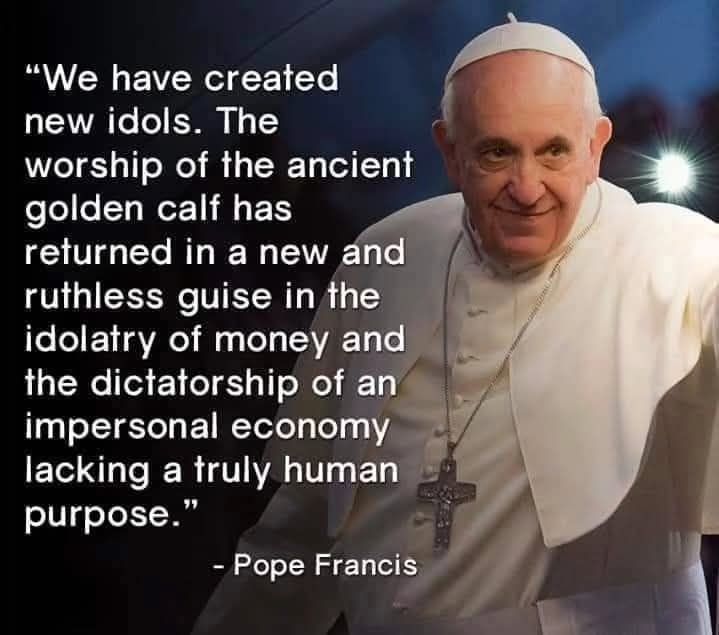
In the traditional media and our social reflection of this – “Belief in markets” – is theological thinking disguised as economics. The market is a god, and economists its priesthood. Modern economic discourse treats “the Market” as: omniscient (“the market knows best”), omnipotent (“there is no alternative”), morally authoritative (“price signals reveal truth”), beyond democratic challenge (“don’t interfere, or you’ll anger it”).
It should be easy to understand this isn’t analysis, it’s faith. When something goes wrong, the response isn’t accountability, it’s ritual: austerity, deregulation, labour discipline, “tightening belts”. This working class suffering becomes a necessary sacrifice to restore god’s favour. That’s why at the #OMN we called this a #deathcult – normal people are expected to suffer and die, quietly, so the invisible economic system can live.
Priests, temples, and worshippers, religions have hierarchy, in this mainstream one: Central bankers are high priests, rating agencies are oracles, think tanks are seminaries, media pundits are evangelists, platforms are temples, metrics are scripture. It’s all theological thinking all the way down, with the surface dressing disguised as economics. The closer you are to god (capital, liquidity, investment flows), the more authority you’re granted. Those far away – workers, communities, the climate – are treated as abstractions, “externalities”. And, like all priesthoods, our elitists claim neutrality while enforcing doctrine.
Heresy is not allowed, questioning the market is treated at best as: naive, dangerous, emotional, “anti-growth”, “anti-business”, “unrealistic” mirroring religious heresy exactly. Then we have the last 40 years of #posttruth, once belief replaces evidence, language becomes performative, words are used to signal loyalty, not to describe reality.
This matters for the #openweb and #OMN as counters to the current path, the #dotcons are the digital expression of this religion, encoding market theology into online control infrastructure with engagement replaces meaning, growth replaces health, metrics replace judgment, extraction replaces any human relationship. This is why the continuing reform inside platforms fails, you’re not tweaking a tool, you’re challenging a faith system.
The #openweb threatens this religion because it decentralises authority, reintroduces human judgment, values trust over metrics, treats technology as means, not destiny. That’s apostasy and why liberal paths to “fairer worship” isn’t liberation, they are at most progressive #mainstreaming that wants more inclusive access to the temple, fairer distribution of sacrifices, representation among the priests. Yes, that has real short-term value for some, but it’s a path, that never questions the altar itself.
The #OMN position is different, we focus on stand up, walking out, building something else. So when we walk away what would a post-religious economics look like?
Signal thinking, not worship, markets as tools, not gods, economics as a social science, not divine law. Values decided democratically, not revealed by price. Survival and care as nonnegotiable, growth as optional, not sacred.
This aligns directly with our insistence on balancing social value and personal value. This unorthodox framing cuts through the mess, calling it religion, we break the spell. People can see faith masquerading as fact, priests masquerading as experts, sacrifice masquerading as necessity, they can no longer pretend this is “just how the world works”. That’s why this language, hashtag story matters. It’s not rhetorical excess – it’s diagnosis – and diagnosis is the first step to composting the #deathcult and planting something that can actually keep people alive.
The following submission was recorded by NLnet. Thanks for your application, we look forward to learning more about your proposed project. Contact
name hamish campbell phone email hamish@visionon.tv organisation name OMN country UK consent You may keep my data on record
Project
code 2025-02-036 project name indymediaback fund Commons_Fund requested amount € 50000 website
https://unite.openworlds.info/indymedia
Synopsis
The #indymediaback is a Fediverse project about rebooting the radical grassroots media network, Indymedia, by anchoring it in trust-based #4opens (Open Data, Source, Process, and Standards). It prioritizes local, collective publishing as the foundation for global solidarity and counter-narratives. The project resists the co-option of #mainstreaming and #dotcons by decentralized, democratic governance and focusing on native, horizontal structures.
Expected outcomes include a revived independent media landscape that amplifies marginalized voices, balancing corporate and state narratives, and builds resilience against #posttruth misinformation. By composting the #geekproblem and embracing simplicity (#KISS), the project empower communities with sustainable, open tools for storytelling, activism, and solidarity. The goal is to seed a flourishing, cooperative #openweb native media as a part of the current activertypub based web reboot.
Experience
I’ve been actively engaged in #FOSS and #openweb projects for over 20 years, focusing on building grassroots, community-driven alternatives to centralized and corporate-controlled platforms. My work emphasizes creating and sustaining open, democratic, and resilient digital paths.
In the early days of the Fediverse, I ran five instances for the first five years, helping to seed the decentralized ecosystem that has since grown into a viable and widely recognized alternative to the #dotcons. This hands-on involvement gave me a deep understanding of the technical, social, and governance challenges of decentralized networks.
Since the launch of the ActivityPub standard, I’ve contributed to shaping the underlying paths that enable decentralized social networking. My work has facilitated discussions, advocating for grassroots perspectives, to ensure that the voices of smaller, community-oriented projects are heard amid broader efforts to standardize and scale the Fediverse.
My involvement includes engaging in advocacy, community building, and technical implementation, ensuring that open standards remain open and accessible. By bridging technical expertise with grassroots activism, I work to mediate the #geekproblem and bring human-centered, trust-based solutions to the forefront.
These experiences directly feed into the #indymediaback project, where I bring not only technical skills but also a rich history of working within collaborative, open frameworks. By combining lessons from past successes and challenges, we plan on contributing to building a robust #openweb ecosystem that stands resilient in these fragile social, ecological and technical times.
Usage
The budget for the #indymediaback project will be allocated to support the development, outreach, and sustainability of the initiative. Drawing on code from Ibis 0.2.0 https://ibis.wiki/article/Ibis_release_0.2.0_-_Federated_Wiki_with_Shiny_Redesign
Platform Development: Core Infrastructure: Building a lightweight, federated publishing platform that aligns with #openweb principles, based on a federated wiki approach like Ibis. This includes robust ActivityPub integration for seamless interconnectivity with the Fediverse. UI/UX enhancements on top of this to show and shape the media flows.
Community Support and Training: Workshops: Conducting training sessions to onboard activists, journalists, and developers onto the platform, focusing on decentralized publishing and governance. Documentation: Creating clear, multilingual resources to empower communities to use and extend the platform independently.
Outreach and Advocacy: Network Building: Expanding the grassroots network by collaborating with existing projects in the Fediverse and the broader #FOSS ecosystem. Awareness Campaigns: Promoting the importance of independent media and the dangers of the #closedweb to engage both activists and potential contributors.
Maintenance and Sustainability: Hosting Costs: Providing stable hosting for early adopters and community-managed hubs. Ongoing Development: Allocating resources for iterative updates, security improvements, and adapting/building code and UX from user feedback.
Past and Present Funding Sources: Historically, the #indymediaback project has operated with minimal funding, relying on volunteer efforts and community goodwill to sustain its activities. Some aspects, such as initial platform experimentation and hosting small-scale instances in the Fediverse, were supported by personal contributions and donations from allied groups.
While the project has not yet received large-scale institutional funding, it has benefited from the collaborative ethos of the #FOSS and #openweb communities. Moving forward, the project seeks to diversify funding sources by exploring grants, grassroots crowdfunding, and partnerships with aligned organizations. However, maintaining independence from corporate or agenda-driven funding remains a core principle to safeguard the radical and democratic essence of the initiative.
The requested budget will act as a seed, enabling the #indymediaback project to transition from concept to sustainable implementation.
Comparison
Comparison with Historical Indymedia: #Indymediaback: builds on the original ethos of news publishing and grassroots participation but adapts to modern needs with more robust and user-friendly technology. The project focuses on federated systems and decentralized governance to avoid the bottlenecks and centralization that hindered the original Indymedia.
Technology: early Indymedia used custom-built CMS platforms like DadaIMC, which were groundbreaking at the time but eventually became outdated. The lack of resources for updates and scalability led to significant challenges as the internet evolved.
Indymediaback: Leverages ActivityPub and the Fediverse, building on existing protocols and infrastructure while maintaining an open and adaptable architecture. This ensures scalability, security, and relevance in the evolving landscape of decentralized web technologies.
Comparison with Existing Fediverse Media Projects
Mastodon and Pixelfed, Flagships of the Fediverse project focused on microblogging, popularized ActivityPub and brought decentralized platforms into mainstream conversations. However, this success has also led to “NGO-style” #mainstreaming tendencies, with decisions catering to wider audiences rather than grassroots paths. Pixelfed: A decentralized alternative to Instagram, Pixelfed focuses on visual storytelling but often lacks the “news” path that #indymediaback seeks to prioritizes.
Indymediaback, unlike Mastodon or Pixelfed, explicitly targets “news” communities and grassroots content. Its focus is on collective storytelling and action, ensuring that it serves as a platform for organizing, not just broadcasting.
Lemmy and Kbin: Are Reddit-style platforms for community-driven forums, Lemmy demonstrates the potential for federated discussion but lacks the tools for journalistic workflows or media dissemination.
Bonfire Networks, is a federated platform emphasizing modularity, Bonfire aims to provide tools for diverse community needs. However, its roots in the #NGO space mean it struggles to align with actually relaverent to grassroots paths.
Expected Outcome: The #indymediaback project revitalize “native” media by combining the best aspects of the original Indymedia—open publishing, grassroots participation, and activist focus—with the technological and governance advancements of the Fediverse. The outcome is a resilient, federated news network that empowers communities to create, share, and amplify their stories, freed from the constraints of corporate platforms and institutional agendas. This reboot provides a necessary counterbalance to the #closedweb and an avenue for meaningful news in these trubaled “post truth” times.
Federated Open Publishing: Developing a robust, ActivityPub-compatible open-publishing system to handle collaborative content creation and moderation at scale.
Scalability and Usability: Ensuring the platform can support diverse communities while remaining accessible to non-technical users.
Trust and Governance: Implementing transparent moderation tools and decentralized governance to balance openness with accountability.
Interoperability: Seamlessly integrating with existing Fediverse platforms while providing unique activist-focused features.
Ecosystem
The ecosystem focus on empowering local activists, citizen journalists, and independent media organizations, providing them with tools for collaborative storytelling, decentralized publishing, and grassroots governance.
Key Ecosystem Actors:
Fediverse Platforms: Like Mastodon, Pixelfed, Peertube form the foundation for connecting and amplifying diverse communities. #indymediaback interoperates with these platforms, enriching the Fediverse with news-focused capabilities while leveraging their existing user bases.
Citizen journalists: community reporters, and activists will be the core creaters of the platform. The project will provide tools for collaborative content creation, transparent moderation, and open publishing to ensure their voices are heard.
Developers and technologists: open-source developers and technologists in the Fediverse and ActivityPub communities will play a critical role in refining and scaling the platform. The project will actively engage with forums like SocialHub to share progress, seek feedback, and align with broader Fediverse standards.
Grassroots organizations: Non-profits, collectives, and activist networks will be key collaborators. By building a decentralized news outlet, the project amplifys their impact while fostering cross-community solidarity.
Engagement Strategies: Collaborative development, hosting regular open sprints, hackathons, and discussions within the Fediverse to build a strong, participatory development culture.
Community support: Dedicated onboarding and user support resources will ensure seamless adoption by non-technical people and communities. Tutorials, workshops, and community-led training will help bridge the digital divides.
Outreach and partnerships: The project will engage with existing Fediverse admins, moderators, and activists to build a coalition for shared goals, promoting the outcomes through federated content streams and cross-platform collaborations.
Let’s look fresh at an old idea, and useful path that is currently being blocked. Ideologies are frameworks for interpreting and navigating the world, the #mainstreaming “common sense” of rejecting them amounts to rejecting structured understanding. When people claim to eschew ideology, they default to the dominant paradigm, the #deathcult of #neoliberalism, without realizing it. This uncritical stance isn’t radical or alternative; it’s a by-product of mainstreaming and the disorienting effects of #postmodernism.
The act of composting this mess is acknowledging and breaking down these entrenched, harmful systems, for the needed, cultivating healthier, more grounded alternatives. Keeping it simple (#KISS) and reaching for that metaphorical shovel is the first step in transforming decayed ideas into fertile ground for the #OMN and other grassroots projects.
So yes, it’s time to dig deep, break it down, and build anew. Let’s shovel together. 🌱
What can you do? Some actions to reclaim the #openweb and refocus on its core principles of trust, humanity, and grassroots democracy is a good first step. The #posttruth era has eroded the integrity of our media, and tools like #Google—once a gateway to knowledge—have been reduced to serving the agendas of #dotcons and more recently the state, leaving us stranded in a desert of noise and distraction.
To take the different path, we need:
Composting the #geekproblem: Our tech culture has long been trapped in deterministic, myopic paths that prioritize tools over people. This “#techshit” needs to be broken down and repurposed, with a focus on social and democratic values rather than isolated, insular designs.
Pushing aside the #dotcons: These thrive on extraction, disconnection, and control. By putting them aside, we free ourselves to create paths and projects that genuinely serve communities, fostering collaboration rather than competition.
Rebooting the #openweb: Grassroots democracy must be central to this effort, with social technologies incorporating human and social needs into their design, ensuring they empower rather than alienate. The #OGB and projects like it offer a tangible path by embedding democratic processes and open collaboration into the fabric of the web.
A simple path is the on i take on this site, the invitation to “click on the hashtags and think” to challenge and break out of default paths of disengagement and passivity. The #OMN isn’t only a tech project; it’s a rallying cry for those who want to see through the mess of the #mainstreaming culture and the #deathcult of neoliberalism.
If you’re reading this and feel the pull, it’s time to act. Visit Statements of Support, sign up, and let’s compost the mess to grow a flourishing, democratic #openweb together. Don’t be shy—this is our moment. 🌱