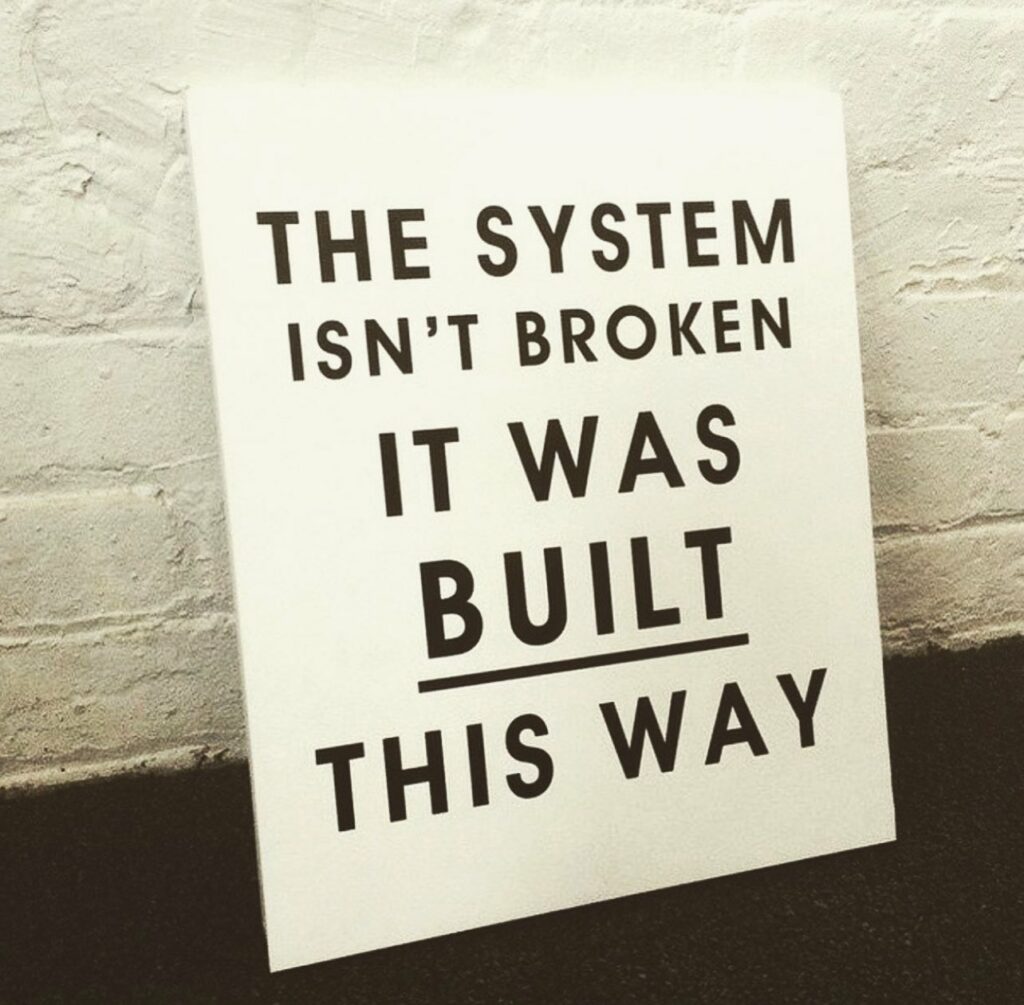
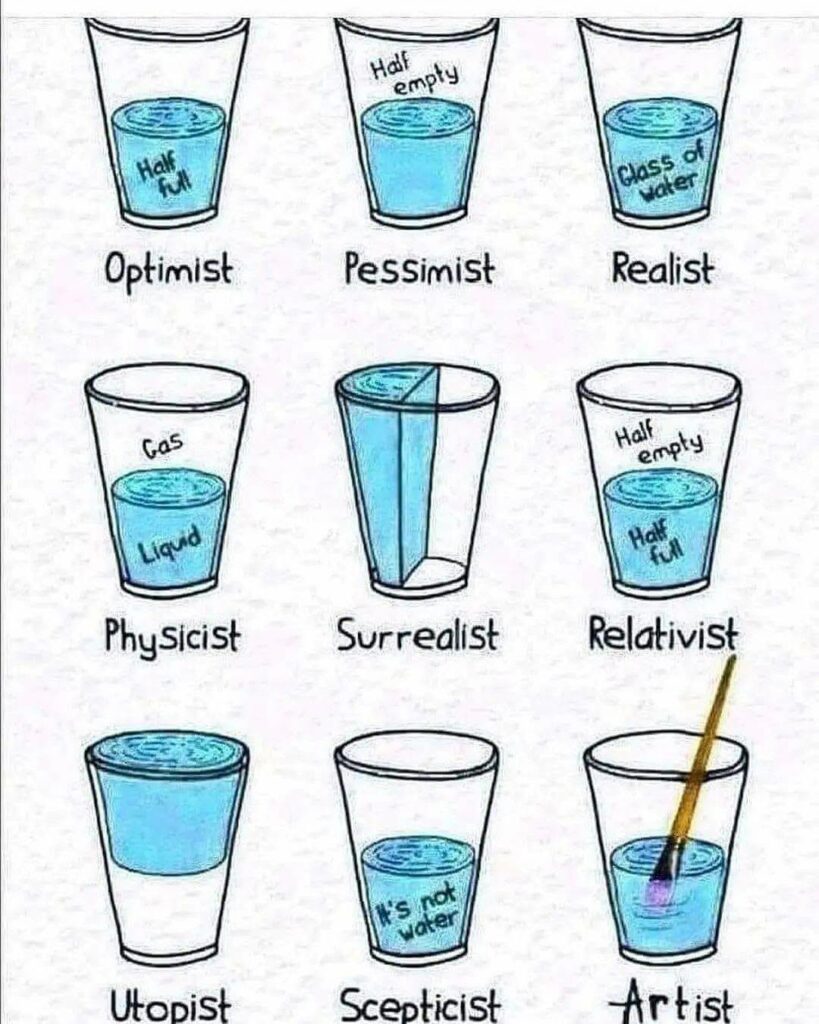
Our current working models of “governance” in open-source projects are Monarchy (the dictator for life), Aristocracy (the devs), oligarchy (the NGO/ funders) and finally way out on the edge Democracy (the users).
If we are to have a positive social impact, we need to consciously shift from these forms of governance to something more based on democratic ideals.
With this in mind we need to recognize and highlight that “governance” it’s a working dysfunctional joke at the movement. To challenge this #geekproblem and the desire for control is a good and useful first good step to making this social technology work in a more humane way.
To make sense of the social/tech #hashtags I’ve been using for the last decade, you need a simple but often avoided tool: ideology. This isn’t abstract theory for academics. It’s a practical way of seeing patterns in how people organise, build, and fight over the world. The idea has been around since at least Karl Marx and Friedrich Engels, and runs through modern political thinking via people like Antonio Gramsci. The core point is straightforward: large groups of people don’t act randomly. They cluster around shared assumptions, about power, about trust, about how the world works. Those shared assumptions are what we call ideology.
Over time, thinkers have “distilled” these patterns into rough categories. Left/right. Socialist/capitalist. Authoritarian/libertarian. These aren’t perfect boxes, but they’re useful shorthand. They let us quickly understand where a movement sits, what it values, and – crucially – how it’s likely to behave under pressure.
Now, here’s the bit people in tech often resist, this applies just as much to coding projects and digital communities as it does to governments or political parties. Code is not neutral, every project embodies choices: Who gets to decide? Who gets to participate? What is visible, and what is hidden? What is trusted, and what is controlled? These are ideological questions, even if developers don’t frame them that way.
Take a simple example – A project built around open standards, transparent decision-making, and shared ownership sits in a very different ideological space to – platform built around central control, proprietary systems, and user extraction. You don’t need to argue about labels to see the difference. But the labels – ideology – help you map it quickly. This is where the hashtags come in. They’re not random slogans – they’re shorthand for ideological positions:
#4opens → a practical framework for keeping things accountable
#dotcons → capitalism applied to network effects and data capture
#encryptionists → a drift toward fear/control when taken to extremes
#geekproblem → the cultural blind spot where technical people ignore social context
Each tag is a compressed way of pointing at a cluster of assumptions and behaviours. Once you see them as ideological markers, the landscape becomes much clearer. So why does this matter? Without this lens, people in tech tend to fall into two traps:
Naivety
They believe they’re building “neutral tools,” and are surprised when those tools reinforce existing power structures.
Confusion
They see conflicts – over moderation, governance, openness – but treat them as personal disagreements instead of ideological clashes. Using ideology cuts through both problems. It lets you say “This isn’t just a disagreement about features. It’s a disagreement about how power should work.” Applying it to real projects.
Let’s look at something like the #Fediverse – It leans toward decentralisation, openness, and community governance → ideologically closer to left/libertarian traditions. But it still contains tensions: moderation, funding, scaling → where different ideological pulls show up.
Or take corporate platforms – Centralised control, data ownership, profit extraction → clearly aligned with capitalist, top-down models
These aren’t accidents. They’re outcomes of underlying ideological choices. The hashtag story is a practical tool, not a purity test. This isn’t about forcing everything into rigid categories or arguing over who is “correct.” Ideology is a tool, not a weapon. Used well, it helps you understand why projects succeed or fail, predict where conflicts will emerge to make conscious choices about how you build. Used badly, it turns into dogma and pointless infighting – which is exactly the mess we’re trying to compost.
The #OMN path is grounded in a clear ideological stance of trust over fear, openness over control and commons over extraction. That doesn’t mean it’s easy or pure. It means the direction is explicit. And that’s the real value here: clarity.
Because if you don’t understand the ideological ground you’re standing on, you end up being pushed around by forces you can’t even see. Once you do see it, the landscape changes. Suddenly, the hashtags aren’t just words – they’re a map.
What do you think *should* be closed? Or at least is OK to be closed?
Let’s start from a traditional liberal view: The majority of social interactions should be done in the OPEN and some private interactions should be done CLOSED.
We can discuss from this.
What the current dogma misses is that just about all good social power comes from OPEN
And meany social evils come from CLOSED
If we close/lock everything down, we are left with the evil, a bad outcome.
There are world-view gaps that make this a hard bridge to hold in place.
Example Diaspora and RSS based networks – the young Turks did a CLOSED network and shouted down the existing OPEN networks… 10 years go by, and we have to reinvent RSS+ as #ActivityPub to launch open networks a new – lets talk more about examples like this when we talk about the #geekproblem and #encryptionists. The 10 years that is missing is the problem.
It’s mostly a view of human nature, thus sociology and politics, applied to social groups who make and use #openweb technology. So if you are new to thinking about this maybe start with some basic wikipedia though the quality has become well muddy over the last 5 years.
A. It’s a valid point that Google and Amazon have monopolist interests and are trying to enforce them. Nevertheless, TLS is an open standard and the owner of that blog would have many other possibilities implementing it. Not having transport encryption is nowadays highly deprecated for good reasons and I don’t see any valid point in not adopting it. Not saying you have to use Google’s or Amazon’s infrastructure for that.
Q. Good to rethink this view. Have a look at his thinking. This is the difference between closed/open as a world view that #encryptionists blow smoke over to push an agender that does not challenge the #deathcult we all live and breath…
A. Sry, but what? 🤔 Encryption is one of the central tools for a free and open internet, as it enables a much better level of privacy, or in fact even is a hard precondition to it.
Q. if you say so… I have been working for more than 20 years on this and always say clearly that we need 90% open and 10% closed – the #encryptionists are dangerously wrong in their view of 90% closed and 10% open. Its a problem we need to overcome and in no way a solution. Take note you are posting this on mastodon that is 90% open and 10% closed. We are not having this conversation on diaspora (the #encryptionists network) very few people are.
A. 1) What the hack is an “encryptionist”??
2) My friend, all Mastodon instances I know use TLS.
3) What is your definition of “open” and “closed”? Encrypted vs. unencrypted? 🤔 I think YOU should really rethink this kind of definition. A blog for instance can be openly available to everyone and still offer secure transport encryption to protect the privacy of its readers.
4) You are mistaken, almost everyone I met on Mastodon is a huge proponent of encryption. And no, I’m not for 90% encrypted and 10% unencrypted. I am for 100% encrypted.
Q. Nuttiness is good in moderation. You are talking to me on a #openweb project, there are some #closedweb one’s, but they tend to be full of nutters, so can understand why you are here 😉
A. You are calling me nuts? Well, thanks… So please define to me, what “openweb” and “closedweb” have to do with encryption per se.
A. Our current dogmas are a mess… good to take a step away.
Q. Uhm… there is nothing written about why encryption is supposed to be bad… It just uses “encryptionists” as some weird swear word. In general, I don’t really get the text. Sounds very confused to be honest. That being said, I am also against neo-liberalism, individualism and esoterics and for an open web. What this does have to do with encryption remains obscure to me…
And it’s not a dogma. It is a scientific fact, that eavesdropping on well encrypted communication is close to impossible.
A. This is an interesting point:
2) all Mastodon instances I know use TLS.
The dev of mastodon told “white” lies about privacy and security as few #fashernistas would go with a #openweb project that did not pedal this dogma.
#TLS is a fig leaf, everything on the server is in plain text and the admins can read most of what you post and the sysadmin can read and change anything. it’s a trust based #openweb project and works well Because of this building of trust.
“Trust nobody” is the rallying cry of conservatism and an easy-to-understand worship of the #deathcult we need to stop pushing this shit.
It would be an #ecryptionst#geekproblem to call any online project secure in any real senses as the operating steam it runs on for 99.9% of users is insecure and likely backdoored for the state and corporate spy. And even if you are in the 0.1% who run something that just might be secure then the firmware is all insecure with issues that CANNOT be fixed in contempery devices…
The mind set is the problem am talking about – you can blow smoke over conversations by not looking at the big picture.
Think we currently have a pile of shit for home hosting tech. Might have to break my #nothingnew pledge as the is literally nothing normal people can use/do. Plan/idea/focus?
Nothing is useable – have tried them all. Good to start from where we are we need to stop going round in circles and start to look at why we HAVE FAILED and if the is a path to failing less badly. Or better how to build something that is not fail.
The is endless circulating in our #geekproblem communities – the subject matters, but we do nothing but circal failer. Good to start from where we are.
We are here… we need social tech that works for normal people…
Update
Maybe build a #KISS set of lightweight apps that use tor as the backend communications standard and talk to the tor browser as web apps so you don’t need the app to dip in, but the apps do the work of lifting p2p hosting. Feasible?
UPDATE (from a chat room on home web hosting)
A. calling everyone’s project a pile shit and not apologising even when some of those project devs sit in this room is not ok
Q. But obviously it’s all well shitty otherwise we would not be in the stinking mess we are with everyone (well 99.99% if you nitpick) on the #dotcons if that is not a pile of shit then we kinda need to start calling a rose a rose and a pile of shit a pile of shit… we are not sniffing roses in this chat i can say this as have been here in the chat for a while and here in the alt tech world for a very long time.
Maybe “wishing” shit way is no replacement for working sewers? We need working p2p tech that normal people can use. So lets compost the shit so we can smell the roses 🙂
A. 🙄 request for moderation plz thanks bye
UPDATE (from a chat room on home web hosting)
A. i concur with *** that the language is neither helpful nor respectful towards people trying to make things. So please mind it.
Q. Fair anufe, though shit in moderation makes good compost and compost is needed for beading seedlings and seedlings grow into everything that feeds life… and https://homebrewserver.club is about grassroots DIY life… some shit in moderation is needed for this cycle 🙂
Let’s water some seeds that “normal” people can grow.
The children of Thatcher and Reagan are limited in their world views – they have been brought up and nurtured in the neo-liberal #deathcult and have limited experience in the nurturing and socialisation of anything else. Academic and book learning are a poor substitute for evolving in a non #deathcult era, so it is no surprise that they find themselves trapped in the circle of #stupidindividualism
In this #deathcult era, individualism is stupid and individualism makes you stupid. This is a degrading circle that no “self-help” or “whoo spiritualism” can help you to escape.
This manifests like dark “social magic” in many areas:
In social movement we have the take-over of #fashernistas who push “alternatives” aside in their “commonsense” self-interest, building careers and grasping at the illusionists of fame and “influence” they are slaves to #mainstreaming
In tech the #geekproblem has pushed emancipation into darkness. The #encryptionists have dominated alt-tech and the #dotcons of the #mainstreaming path, both are born of this world view and the socialisation that keeps it from sight.
The mainstream is blind in its worship “there is no alternative” for #mainstreaming agendas in this era. Our words and actions are simply spewing shit while the world burns, our ecosystems die and communities implode in manufactured (for profit) infighting #failbook
It’s actually easy to step away from this mess, the issue is: are you brave enough to fall and WILL your community catch you when you do? (both valid worries i’m afraid).
We need hand-holding and most importantly we need alt-social/tech structures in place to build and bind – all human communities are built/bound with/from these structures.
The #OMN and the #4opens are there as shovel for the shit and binding for the community – neither of these have any power but the power you use them with – the steeping and away and dreaming and digging is all down to you and your community.
If you look at contemporary programming, I don’t think we have properly understood the social damage that our coding culture has already done, and is still doing. We have built enormous parts of modern life out of software, while pretending that software is somehow separate from society. It isn’t, code structures how we communicate, what we can see, who can participate, what gets remembered, what gets deleted, who gets heard and who gets ignored. And much of contemporary programming culture has a deeply contradictory relationship with this power.
In theory, the culture talks like anarchism: decentralisation, freedom, hacking, autonomy, permissionless innovation, open protocols. In practice, the resulting infrastructure feels closer to an authoritarian bureaucracy: rigid hierarchies, centralised control, surveillance, locked-down permissions, opaque decision-making and an almost obsessive belief that more control and more security will produce a safer society. This is part of the #geekproblem.
Closed systems hide power – in a #closed system, the monsters can operate without being easily seen. They can plot, manipulate, divide and control because the surrounding community cannot properly see what is happening. There is no shared social process for checking the claims being made or comparing them against what everyone else can see.
You cannot easily create social “truth” inside a closed system, you can have an official truth, corporate truth, an algorithmically manufactured truth. You can have whatever the people controlling the system want you to believe. But social truth is different, it emerges from people being able to see, question, compare, remember and challenge what is happening, that is one of the powerful things about #open. With genuinely open systems, the monster becomes more obvious. It becomes easier to see the relationships, the decisions, the contradictions and the consequences.
It becomes easier for other people to say – hang on, that’s not what happened – open systems don’t magically prevent abuse, they don’t make people good, but they make some forms of abuse harder to hide. Closed breeds monsters. Open pushes them out of the shadows where they can be seen.
The security paradox – this is where programming culture gets particularly strange. The demand for control and security is to often presented as neutral engineering. We are told that systems need permissions, authentication, central administration, surveillance and increasingly complex layers of security because the world is dangerous.
Of course some security is necessary, but when security becomes the organising principle of the whole system, something changes, the technology begins to reproduce the social assumptions of its creators. People become permissions, communities become accounts, relationships become access-control lists, trust becomes authentication and thus social problems become technical problems. Uncertainty becomes something that must be eliminated rather than something that society needs to learn to live with – this produces systems that are technically impressive but socially impoverished.
The fantasy of perfect control is a deeper problem here. We keep trying to build technology that removes mess, but human society is messy. People disagree, misunderstand each other, change their minds. Communities develop traditions as different groups have different needs. Sometimes things fail or somebody has a better idea, that isn’t necessarily a bug, it is social life. The #geekproblem treats this mess as something that technology should solve. The result, an endless attempt to build cleaner abstractions over increasingly complicated social realities. But the cleaner the technical abstraction becomes, the more human reality gets pushed outside the closeing system.
Then the system becomes brittle, and when it breaks, everyone is surprised. Code should be allowed to be messy – this doesn’t mean writing bad code. It means recognising that good social technology cannot be based on the fantasy of perfect control. We need systems that accommodate disagreement, forks, experiments, mistakes, local variation, negotiation and repair. In that sense, code should be a little bit messy, because society is messy. The goal isn’t to eliminate the mess, it is to create structures that help us live with it. That is different from the programming culture of trying to close every possible hole, define every possible behaviour and control every possible interaction.
#OPEN is a direction, not an endpoint – there is also a danger in treating #open as another purity project. Yes, the #openweb isn’t automatically good as open systems can contain abuse, misinformation, exclusion and power games. The #openweb itself contains plenty of contradictions. The #dotcons have their own versions of “openness”, often while retaining enormous concentrations of corporate power. So this isn’t a simple story of good open people versus bad closed people, more a balancing process.
#OPEN is a way to step away from #CLOSED – it creates space for transparency, plurality, experimentation and social accountability, gives communities more opportunities to see what is happening and to build alternatives. And that matters because we are currently living inside an enormous pile of inherited closed #techshit – closed platforms, closed data, closed algorithms, closed governance, closed infrastructures and assumptions about what technology is supposed to do. As a first step we need to compost a lot of this closed crap.
The mistake, we make to often today, is that we believe that we can build the perfect open system and finally end the struggle, we can’t, and we shouldn’t. There is no final technical architecture for society. There is no perfect governance model, no moment when we finally solve disagreement, power or human contradiction. Anyone promising that is either selling something, hiding something, or has fallen deeply into the #geekproblem.
The point is not to end the mess, it is to keep the mess visible, social and negotiable. We need technology that leaves room for people to challenge each other, organise, experiment, repair and move in different directions. That is why the #OMN work matters – to build practical #openweb infrastructure where media, metadata, moderation, governance and community relationships can remain visible, shared and contestable.
To make this happen we need #4opens starting points, #OGB experiments with governance, #MakingHistory to keep collective memory alive and #IndymediaBack to remember what grassroots media learned before the current wave of #dotcons.
Q. While I agree with everything you wrote in that post, I don’t get how that illustrates the geekproblem. Is the #geekproblem the same as the #encryptionists?
A. The #geekproblem is illustrated here http://hamishcampbell.com/index.php/2021/03/06/over-the-last-10-years-we-have-been-told-a-lie/
Q. In one post you wrote that the geek problem is replacing trust with control. That immediately communicated clearly to me.
A. The #geekproblem is a general issue of misunderstanding of “total control” and what it is to be human. The #encryptionists are an example of this, that have been dominate for the last 10 years, the solution to everything is “privacy” “lock down” isolated individualism, me only me “no such thing as society only individuals and their family’s”.
The hashtags have different meanings if you look at them from different directions – but always #KISS and radical at base. Metaphors, soft knowledge. The are no hard definitions – but add them together and they tell a story of “control”. The opening is that YOU have the opertinertly… maybe its a bit Qanion, first time I thought about that one 🙂
Q. I assume open data, which is good in some contexts but shades into surveillance in others.
Open processes? Which again I like in most of the contexts I work in,
What else?
A. The is a few pages http://hamishcampbell.com/index.php/projects/4opens its a radical “social” definition of the open-source/free-software process. #4opens can be used to judge any tech/social project. It’s needed to lift the lid on what #dotcons and #NGO say and what they actually do, always different. If people make judgments it’s likely to put to one side 95% of the current tech crap and concentrate on real #openweb projects that get lost in the churning of #fahernista and #geekproblem agenders.
With #opendata currently we have a control issue. All the #dotcons data is open to corporations who pay and government agencies who spy, it’s just closed to us. What is the role of data in society is a complex issue that we do almost nothing to talk about in any real sense.
Social (data) ideas to think about:
What is a “free-market”
A. Ain’t no such thing and never has been nor will be
What is a command economy.
A. Any capitalist supply chain.
What are humane relationships.
A. longer conversation…
Q. But this is such a thing as a “free-market” in inverted commers 🙂 it’s the data we have on the things we “value” which we exchange for “data” that is created and guarded by our “states” with lots of guns and bombs.
A command economy is what the soviets tried and failed and china is trying to recreate with a state “manoalay” on data and metadata.
The “humane data” is the interesting one for #4opens and #OMN which are planting seeds for.
Metaphors are human thus soft, were code is hard and machine. But something we often do not see is that machines are made/invented/imagined by soft humans, so the idea of hard logic is ALWAYS backed by soft. This is why not seeing the world with thinking and emotion “ideology” is it self a blindness, that is a root of our current mess. This explains much of the “code” the #geekproblem makes to shape our digital world, we need to move past much of this mess to START to shovel compost and plant the seedlings for a more humane world.
The #geekproblem is a humane failure of trust and its replacement with control.
The #hashtags add up to tell a story and thus build a way out of this mess.
The #deathcult is the last 40 years of neo-liberalism.
Need to work in shovels, shit and compost to the story. Hashtags a tool for #openweb organizing ideas/stories/community’s. The is obviously a balance with self-expression. At the moment this “balance” is pure #deathcult being pushed by our shared #stupidindividualism
We have a #shoval, common storied #hashtags we have piles of #techshit to shovel for #compost to build up fertile soil for planting flower and vegetables to nourish our soles and actions.
Why talk in “soft” metaphors?
The issues are soft as are the explanations/metaphors. You can’t have a hard explanation of the social world without building it up from an ideological foundation. As most people are in denial of the possibility of different world views/ideologies this makes “hard” conversations a largely pointless way of communicating. People asking for them have not taken the first step so talking their hand to help them will soon lead you down a different/ideology path. As the project is about #KISS and focus this is something we have limited time/focus for.
If you can glimpse the world from different views/ideologies than the soft/metaphor will talk to you and the attraction for hard will be less strong. These people have a hope of building a different/ideology world/process so can help in real ways.
As we need to focus, it’s not an issue to talk to the first and more important to consolidate around the second… question is finding people that have not been “broken” by #mainstreaming agenders.
Q. I am looking for the definition of open standards, and it’s quite foggy. I found on opensource.com something useful, but it’s still a candle in the dark
A. it’s an under resourced process for the #openweb that need input. It’s at the heart of the #OMN project. How we define it at the #OMN is a standard produced with #4opens process which is a bit circler as open “industrial” standards is one of the #4opens 🙂
All “standards” are social agreements/consensuses thus they CANT BE built form #geekproblem#stupidindividualism and the #deathcult we have wasted and will waste more time if we keep pushing this shit.
The idea of the #OMN is that it does NOT host any/meany of projects it incubates rather it is the “holder” of the standards that glues the projects together. Some of these will be “standards body” some will be defacto by use and consensus. In the end we need to look beyond #nothingnew and create new standards #4opens body’s – go slow on this as concessions are hard and only worthwhile if you do the hard work to achieve them.
Too much built in alt-radical tech ends up feeding pointless #fashernista churn. New platforms, new protocols, new branding, new codebases tend to be endless motion with very little grounding in actual social need. People mistake novelty for progress, and the result is a constant cycle of abandoned projects, burnt-out developers, and fragmented communities.
That’s one of the reasons why #indymediaback matters. It is not another pointless radical tech project chasing fashion. It grows from the #nothingnew path, building around things that already worked socially, culturally, and politically before the current mess swallowed the #openweb.
The point of #nothingnew is not nostalgia, it’s mediation. Instead of endlessly reinventing tools and social structures, we look at existing working practices and compost the failures while keeping the value that already exists, we build from continuity rather than disruption.
For the first 5 years of the #fediverse, this often means creating #openweb replacements for existing #dotcons platforms. That has value, people need usable alternatives to corporate systems, but simply copying the logic of the #dotcons into federated code has real limits.
Code is never neutral, all code carries embedded assumptions, social relations, and ideology. When we directly replicate #dotcons platforms, we import the values of the #deathcult along with the interface design. Metrics, branding, influence economies, performative identities, engagement addiction, soft/hard hierarchies – all this gets reproduced inside supposedly “alternative” spaces.
This is where the problem needs mediating rather than denying. The path of #indymediaback is different because it starts from an existing radical social process, not from abstract tech blindness. #indymedia already had working publishing flows, distributed trust networks, collective moderation practices, and real-world activist communities. The technology existed to support those social relations, not replace them.
That means the real value of #indymediaback is not primarily the tech stack, even though the tech matters. The value is in rebuilding the social continuity that made the original project meaningful. Without that grounding, you likely just produce another empty platform that disappears into the pile of forgotten radical tech experiments.
Food for thought: the #geekproblem is often not actually interested in the #openweb as a human value network. Instead, parts of geek culture feed parasitically off the current mess – thriving on fragmentation, novelty churn, status games, and technical abstraction disconnected from lived social reality.
Feeding off the collapse of the #openweb while calling it innovation is still bowing down to the #deathcult. Seen this way, the need for change becomes clearer, that we need active mediation, not passive drift. Both carrot and stick. Support grounded projects that grow from real communities, and challenge the pointless churn that keeps draining energy away from building durable alternatives.
The #OMN is one attempt at this – a shovel for composting the inhuman mess, so something living can grow from it.