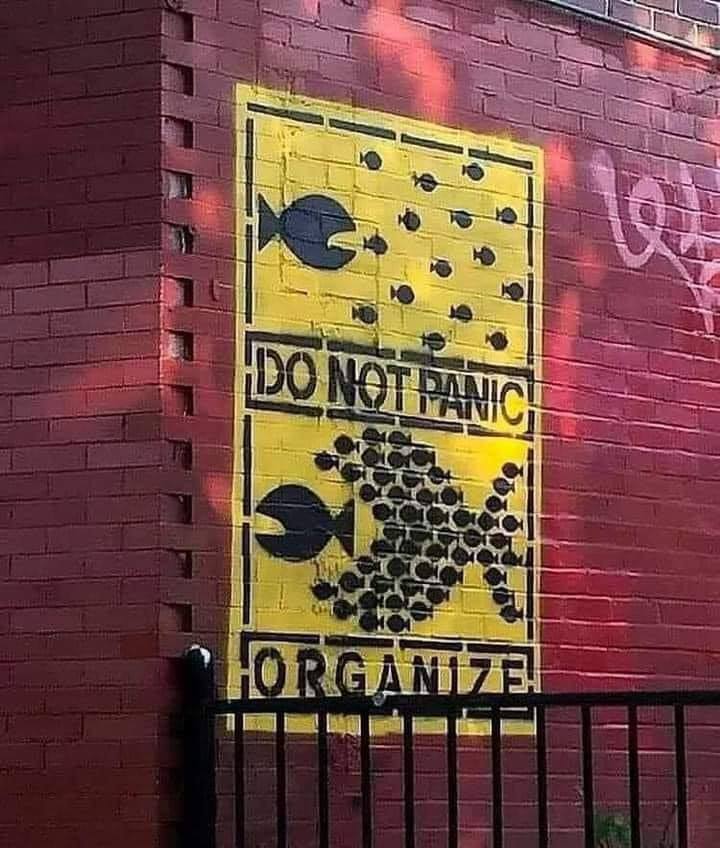
“Working groups (#WG) have one job – get things done, they don’t need permission for every step – they need to report openly, consult when it affects others, and hand back decisions that are too big for them to own alone. That’s it, that’s the whole structure.”
One of the biggest recurring naiveties of horizontal organising is the belief that every decision needs to be made by everybody. This sounds democratic, but in long historical practice this leads to endless meetings, burnout, frustration, and eventually informal hierarchies where the people with the most time, confidence, or stubbornness end up making decisions anyway.
The result is a process that appears horizontal while quietly becoming ineffective. A simple principle cuts through much of this mess – Working Groups (#WG) have one job: get things done. They do not need permission for every step. They do not need endless consensus rounds, do not need to return every small decision to the collective, they need to:
- work openly
- report regularly
- consult when their actions affect others
- hand back decisions that are too large for them to own alone
That’s it, everything else is unnecessary.
The purpose of a working group is not to represent the collective. It is to carry out practical work on behalf of the collective. If people have agreed that a task matters, then the group trusted with that task needs the autonomy to do it. This is the difference between #4opens governance and bureaucratic administration.
To make this work we do need to compost some mess, we have the trap of process fetishism, many activist groups develop what can only be described as a fetish for process. Every decision becomes a collective decision, disagreement becomes crisis, and every proposal requires multiple rounds of consultation. The intention is usually good, people want participation, accountability, and fairness. But the outcome is the opposite, the people doing practical work become exhausted, new people struggle to engage, urgent opportunities are missed, and hidden power emerges behind the scenes. What looks democratic becomes an all to familiar form of paralysis.
The irony is that this benefits the existing informal leadership. When formal decisions become impossible, influence shifts to whoever has the strongest social networks, the loudest voice, and the most time to spend in meetings. The supposed “open” process becomes a mask for power rather than a challenge to it.
Healthy horizontal organising is not about removing responsibility, it is about distributing responsibility. People take on work, groups take on tasks. Decisions are made at the lowest level possible and issues only move upwards when they genuinely affect the wider collective.
This keeps decision-making close to the work itself, as the people closest to a problem usually understand it best. The wider group only needs to step in when questions become collective questions. It’s a #KISS working path with a long history that creates a living structure rather than a bureaucratic one – healthy movements should feel more like a network of trust than a chain of command.
The challenge is not only structural, it is emotional, organising through feelings, relationships, identity, and emotional response, is not inherently bad, as movements need care, solidarity to build people to people who support one another, without this emotional connection, activism becomes mechanical and brittle.
But there are too sides to this, when emotional comfort becomes more important than practical outcomes, problems emerge. Conflict becomes difficult, criticism becomes threatening leading to accountability becoming personalised leading to disagreement becoming interpreted as harm. The result is that difficult conversations are avoided until they explode, groups become trapped between politeness and resentment so nothing gets resolved. This is where the debate between fluffy and spiky becomes useful.
- Fluffy practices build trust.
- Spiky practices solve problems.
Healthy organising needs both, but too much fluffy and nothing changes. Too much spiky and people burn out. The art is finding the balance.
The foundation of horizontal organising is trust – Trust people to take initiative, working groups to carry out agreed tasks. Trust transparency more than control, trust report backs more than permission, accountability more than management. The goal is not to eliminate power, it is to make power visible, distributed, and accountable.
That means allowing people freedom to act while ensuring the collective remains informed and able to intervene when necessary. A working group should never need permission to do its job, if it does, then either the group has not been trusted with the task, or the collective has not yet decided what it wants. In both cases, the problem is not the working group as good process should help people act together, not prevent them from acting at all.
Trust the work.
UPDATE Q&A
Q: I agree, but how do we even set them up?
Use the WG (Working Group) as they are designed to solve this problem. They are spaces of action. Because they are small and focused, they naturally filter out the people who are there only to block, endlessly discuss, or avoid action. The word WORK has an effect.
Q: But where do the people come from? We need people.
WGs are permissionless – you don’t wait for a structure to approve them. You call one, a few people (or even just one person to start) come together, focus on a task, and make decisions. Then you feed those decisions back into the wider group. Feedback happens – or it doesn’t. Then the WG gets on with the work, adjusting based on useful feedback, and reports back openly. Then you move on to the next decision. The important thing is that this can start small, it could be one person, but it works better with a group of committed people.
As people see real work happening, they join, or they don’t. Over time, a campaign grows and the WG becomes the place where committed people organise, while larger meetings remain open spaces where everyone can have a voice. The WG listens, but it also has to make decisions and move forward.
The key is that it always operates through the #4opens – open process, open communication, and open access – so people can see the work and join in if they want to. Action creates momentum.