Why do we keep bringing this up?

If we want a better web, we have to stop pretending this is just about “bad tech companies doing bad things.” Of course, they are-that’s what capitalist incentives produce. The real question is: what are we doing differently?

That means accepting some uncomfortable truths. The better path will be less convenient, at least at first. We will have to socially support things that used to look free on the #dotcons. Because the cost we didn’t want to face is simple: the #openweb was always going to be harder, someone has to:

  • run the servers
  • maintain the software
  • fund development
  • handle abuse, moderation, and #UX

The fantasy wasn’t that this work didn’t exist. The fantasy was that the market – advertising – would cover it without consequences.

In the current mess in tech paths, this becomes visible again. Bluesky and #ATproto keep getting lumped in with #ActivityPub under the easy label of “open protocols, yay”… but that’s just not true. Yes, they both sit in the #openweb space, but there’s a real structural problem here, and we’re seeing it play out in real time.

At AtmosphereConf, the signal was stark:

“Why would anyone fund an Atmosphere project if Bluesky, with $100 million in the bank, might ship a competing feature at any moment?”

That’s not an ecosystem. That’s a platform with enough gravity to crush its own edges. And people are noticing. The old pattern is back:

  • invite the community in
  • let them build the value
  • then absorb and replace them

Same playbook, again and again. It feels open – but the centre still holds the power. The same dynamic we saw with Twitter. The DNA is obvious.

The difference really matters. #ActivityPub was built as a commons path from the start – messy, flawed, but natively open. #ATproto is something else: a platform-first model with openness layered on top. That’s why it keeps drifting this way. It’s not a bug, it’s the design.

Too much #techshit, and everything starts to stink. Why would anyone step into the #openweb if that’s the smell? This creates a bigger problem, that it’s a mess that keeps coming back, and as usual we’ll be the ones left to compost it, underfunded, unrecorded, and unthanked.

We’ve been here before – with the #encryptionists and the #blockchain mess. Big promises, lots of noise, overlapping hype cycles. Now there’s a clear overlap with #Bluesky and #AI. The risk isn’t just that this fails. It’s that when it fails, it leaves a miasma behind, making it harder for people to trust the actually working open paths. That’s the real damage.

Neglect is not innocence, this isn’t about blaming users instead of power. Power matters. Monopolies matter. Venture capital mess matters. But still, if the #openweb mattered, why didn’t we support it?
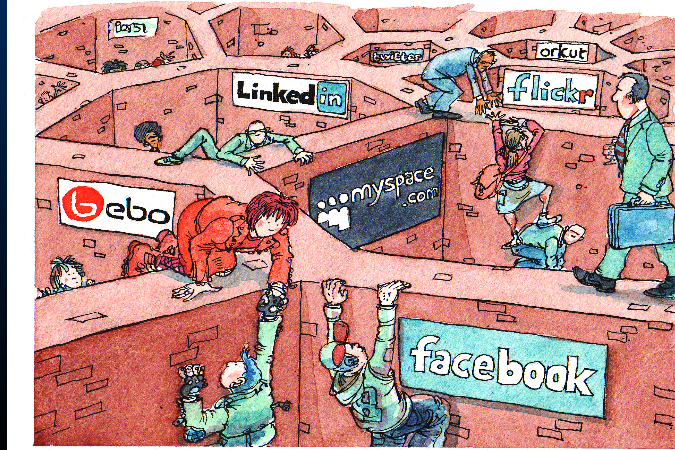
Why do people pay for streaming, cloud, and delivery, but not support publishing tools, independent media, hosting, or open infrastructure?

Why did so many #NGO organisations that talked about openness still push people onto closed platforms the moment growth and analytics are on the table? We keep choosing short-term convenience over long-term stewardship, not just a market failure, a cultural one.

So lets look at this mess again. I’ve been trying to find a way to express my view of the people who took over outreach in the #Fediverse, and in doing so helped shape the current #openweb reboot.

DRAFT: naïve, controlling, and self-interested.

They’ve left a mess that the people they pushed aside now have to compost. It’s really useful to look at how we got here.

In the early years, outreach was organised by a genuinely diverse, native crew. It was a good time – three open conferences, and even getting the EU to adopt the standard. But that group burned out, focus splintered, self-interest crept in, driven by the need to control resources. The balance shifted, and grifters gradually outnumbered them, eventually tearing it apart. In the space left behind, a new crew stepped in – filling the vacuum with centralised power and influence. And that’s where we are today.

We don’t fix this by arguing harder. We fix it by building – and holding – open spaces that don’t follow this pattern.
It’s not about features. It’s about culture.

#ActivityPub comes out of the #openweb tradition.

#Bluesky comes out of a split lineage – #openweb roots, shaped by #dotcons incentives, with an #encryptionist upbringing.

Why the #OMN works with #ActivityPub – And why we need a bridge to #p2p

Let’s look at this. #ActivityPub is not a product. It’s not even really a “protocol” in the narrow, rigid sense that vertical tech likes to imagine. ActivityPub is a shared vocabulary, a public language for moving meaning and connection across the #openweb. It gives you nouns and verbs, and the community defines the grammar through lived use.

This is why the #OMN works with ActivityPub, a metadata and meaning layer, not a platform, flows, not silos. ActivityPub is the widely deployed #4opens protocol that treats publishing as a flow, a conversation.

Unlike the more vertical stacks (#ATProto is a good example), ActivityPub doesn’t force a worldview. It doesn’t tell you, “this is how your network must be structured.” It doesn’t enforce hierarchy or lock you into one interpretation of identity, authority, or workflow. It’s a #KISS path – here’s a shared language, verbs for publishing and receiving, express objects, updates, relationships. The rest is up to the commons

This flexibility is exactly why the #OMN can become a part of this flow. ActivityPub, with #FAP process, is already evolving this way – not through top-down committees, but by developers and users defining new grammar for shared needs. Quote posts, permissions, object types, and many other extensions are emerging organically. This is horizontal protocol evolution, which aligns well with the #OMN path.

To mediate the #geekproblem trying to break this path. We need to say clearly why we don’t want an “ActivityPub 2.0”. A clean break is a vertical move, it reproduces the #techcurn cycle: throw away the compost, start another shiny stack, burn everything down every five years because fashion demands it. It’s the #fashernista mindset applied to protocols.

For the #OMN, we need continuity, evolving the commons, not abandoning it. ActivityPub works because it’s an accretion protocol, not a replacement protocol. We extend it, we add grammar, we build bridges, we compost the broken bits. This is the #nothingnew ethos: repair, adapt, extend, don’t rewrite reality every cycle.

This is fine up to a point, but still too much – Central points of failure – Which is fine for much of the #fediverse. But the #OMN isn’t only for well-resourced servers, it’s for change and challenge. Activists on the ground, communities without reliable hosting, people under surveillance, low-resource groups, offline-first publishing, pop-up networks, autonomous movements that cannot rely on central infrastructure.

For this layer, we need true #p2p protocols. This is where #DAT, #Hypercore, and similar tools matter – not as replacements, but as bridges. These are needed for resilient metadata flows, where stories, tags, and meaning travel across networks even when the networks are broken.

We need to understand why both matter, It’s because they do different things. ActivityPub gives us: wide distribution, discoverability, moderation structures, federation, slow-moving cultural infrastructure. We add to this what #p2p gives us: autonomy, resilience, offline survival, local-first publishing, anti-censorship pathways,

The #OMN’s job is to bridge these layers, same metadata vocabulary, same hashtag meaning system, same open processes. Two different transport layers depending on the need. Think of it like the compost metaphor: ActivityPub is the shared soil bed. #p2p is the mycelium running underneath, keeping it alive when storms hit.

This matters, we don’t want just another Fediverse, we don’t want just another p2p experiment. We need a living ecosystem that can: publish everywhere, survive disconnection, resist capture, remain open, remain public, remain messy, remain ours. ActivityPub gives us the public commons, p2p gives us the underground root network. The #OMN ties them together through shared metadata, hashtags, practices, and governance.

Compost, not silos, ecosystems, not empires. Federation on the surface, peer-to-peer underneath. This is the #OMN path.

Comparing Decentralized #openweb Protocols

The #socialweb is shifting away from corporate-controlled paths like #Twitter and #Facebook toward decentralized, more #DIY alternatives. The idea is simple: instead of a single company having control, decentralized protocols allow different platforms to connect while giving people the power to shape and control their digital paths.

Three major decentralized protocols have emerged:

  • Fediverse (#ActivityPub) – The most established and widely used, forming a “native” backbone of the #openweb.
  • Bluesky (#AtProto) – A Twitter-funded project that claims decentralization but is still highly centralized.
  • Nostr – A relay-based, censorship-resistant protocol with interesting tech but major cultural and usability challenges.

While all three claim to support decentralization, only ActivityPub (the #Fediverse) actually delivers on this promise. An overview:

The Fediverse (ActivityPub) – The Decentralized #openweb

Background & history, the Fediverse is powered by ActivityPub, a W3C-recommended standard, since 2018. Unlike Bluesky and #Nostr, which are still evolving, ActivityPub is already a mature, widely adopted protocol. It was designed from the ground up, through a 20-year unbroken history to enable interoperability between platforms, meaning people on different apps can communicate seamlessly.

This #ActivityPub network exploded in popularity after Twitter’s collapse under Elon Musk, with Mastodon seeing millions of new users in 2022. Now there are meany popular apps & servers, it not just one platform – it’s a whole ecosystem of independent apps that mostly copy #dotcons:

  • Mastodon – The most well-known microblogging platform, often compared to Twitter.
  • PeerTube – A decentralized YouTube alternative.
  • Pixelfed – A decentralized Instagram-style photo-sharing app.
  • Pleroma / Misskey – Alternative microblogging platforms.

ActivityPub works through federation: Different servers (instances) talk to each other, creating a #4opens network of networks. How this works, you create an account on one instance, but interact with people across the entire Fediverse. Each server is independently operated, meaning no single company owns the network. There is an issue of instance Lock-In: If a server shuts down, yes, people must migrate manually, but this is a small tradeoff compared to the massive corporate control seen in more #mainstreaming paths.

Bottom Line: ActivityPub is the most decentralized and established protocol, already powering a thriving ecosystem of apps with real communities.

#Bluesky (AtProto) – Fake Decentralization, A shadow #Dotcons


Background & history, Bluesky started as a Twitter-funded project in 2019, originally backed by Jack Dorsey. It claims to be building a decentralized social network, but in reality, it’s architecture favers centralization, due to it being built to prioritise scaling. The #AtProto, allows for theoretical federation, but in practice, Bluesky is still a Twitter clone controlled by a single company.

Popular Apps & Servers

  • Bluesky – The only major client, self-hosting is possible, but current federated servers are limited to 100 users, and Bluesky can refuse to federate with them.

How AtProto works: #DID-based identities – Users can theoretically move between services, but only if Bluesky allows it. Centralized moderation – The vast majority of users rely on bsky.social, meaning Bluesky still has the power to block or censor at will. Limited self-hosting, Bluesky restricts who can run a server and limits federated instances.

Bottom Line: Bluesky is currently a trap, a con, It looks decentralized but is a #dotcons, the normal corporate-controlled path.

Nostr – Interesting Tech, but bad culture

Background & history, #Nostr (Notes and Other Stuff Transmitted by Relays) was created by an individual in 2020 as a censorship-resistant social protocol. Where ActivityPub and AtProto, use server-based networks to build community and distribute moderation, Nostr uses a relay-based model where users broadcast messages across multiple relays. It gained popularity in #Bitcoin circles and received funding from Jack Dorsey (again).

Popular Apps & Clients

  • Primal, Nos, Snort – Web-based clients.
  • Damus – iOS client.
  • Amethyst – Android client.

How #Nostr works, It is Relay-based, with no community focued on instances – no centralized servers, messages are published to multiple relays. Cryptographic Identity – people have opaque public/private keys instead of usernames. No true federation – people rely on relays to store and transmit data, but relays don’t communicate with each other like ActivityPub servers do. Difficult for adoption – The reliance on cryptographic keys makes it confusing, and there’s no built-in moderation system, so comminutes remain fragmented, its tech for the native #stupidindividualists paths. But still, in this, diversity is good and as it bridges it might become a useful project.

Bottom Line: Nostr is decentralized and censorship-resistant, but it’s not user-friendly or practical, its culture is a bad mix of #techbro and #geekproblem #encryptionist #shitcoiners


Which Decentralized Protocol is the Best?

ActivityPub (Fediverse) is a clear winner, it’s proven, widely adopted, and already functional with true federation across multiple apps, decentralized and people-controlled. Where #Bluesky (#AtProto) is a hidden #Dotcons which claims to be decentralized but is still controlled by Bluesky, Inc. Federation is limited, and self-hosting is discouraged thus is a Trojan horse for another corporate-controlled network. Nostr is interesting but niche, completely decentralized, but difficult to use. No federation between relays and not practical for mass adoption.

Final verdict: If you care about real decentralization, community, and people, ActivityPub (#Fediverse) is the clear choice.

What is needed next is to take the step in the Fediverse of moving beyond simply copying the #dotcons. It is time to reboot the #Openweb with a project like the #OMN. The Open Media Network is about taking control of our digital paths and building a future beyond the #dotcons. If we want a truly decentralized internet, one core message is that we need to support ActivityPub-based paths instead of getting fooled by corporate-backed “alternatives” like #Bluesky.

Join the Fediverse today: https://fediverse.observer/ It’s past time to reclaim the #openweb to build digital spaces that work for people, and the social change challenge we so urgently need.

One thing is clear, you can and need to walk away from the corporate #dotcons.