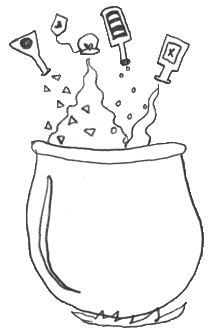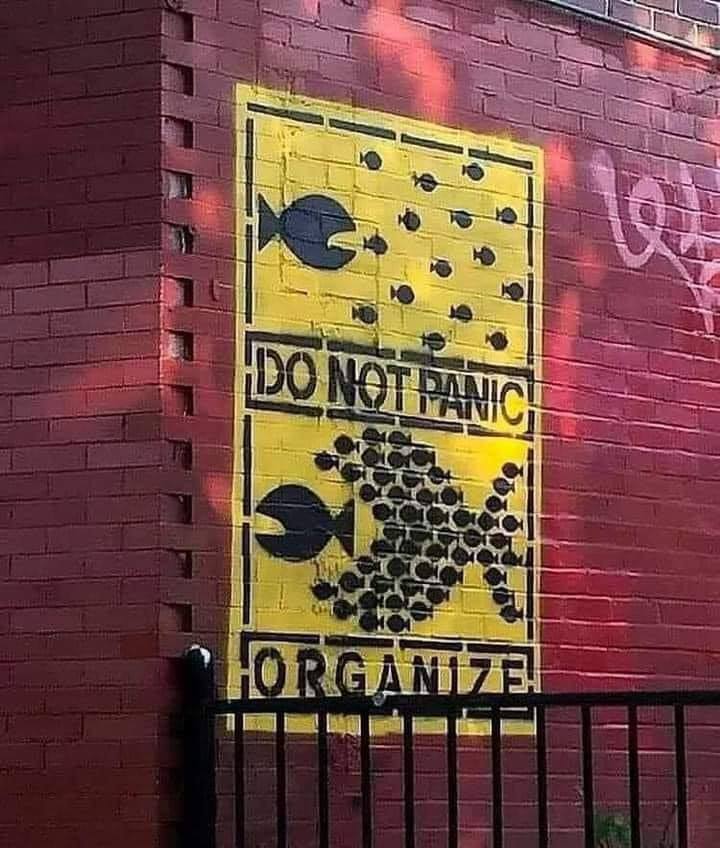
At #NOAW event I talked a lot about the digital commons so thought it might be useful to write a post grounding this. The digital commons are not a future vision, it’s something we already have. At its simplest, the digital commons are the widely used #4opens digital resources of software, knowledge, data, and culture created collectively, governed by communities, and made available for public (re)use. This is the native path of the #openweb it’s been around for a long time, it might be hard to see but just about all of our current #dotcons mess is built on top of this layer.
There is a long history of commons in wider society. But mostly today we focus on the licences that protect reuse and sharing. None of this is abstract theory, it’s making the practical, working infrastructure that underpins much of what people still find useful online. One of the roots of the current digital commons go back to the 1980s and the emergence of the free software movement, led by Richard Stallman and the Free Software Foundation. This was not just about code, it was a social and political project:
- Software should be shared
- Users should have control
- Improvements should remain in the commons
The creation of the GNU General Public Licence was the first step, enforcing a simple rule that if you benefit from the commons, you give back to the commons. The commons isn’t one thing, it’s an ecosystem – Some #KISS examples include:
- Wikis – collectively written and maintained knowledge (#Wikipedia)
- Open source software – built in public, shared freely (#FOSS)
- Public code repositories like GitHub used to be (name one)
- Open licensing systems like Creative Commons
- Federated social tools built on ActivityPub (#Mastodon)
The Path is governance by the people who use it. What makes the digital commons different from “just free stuff” is this the people building it can shape how it works, a key distinction it’s not just access – it’s agency. The commons are non-exclusive (available to others), oriented toward use and reuse and governed by its participants, this is why it matters politically.
Today, much of the internet still runs on the digital commons, but the visible layer is dominated by #dotcons platforms. This creates a split of Commons layers → open, slow, sustainable and Platform layers → closed, extractive, growth-driven. People still rely on the commons, but interact through closed systems, this contradiction is unstable.
Policy is our current-missed opportunity, as our institutions see only the surface value. The European Union’s European Commission has pushed open source strategies as part of digital sovereignty, particularly through programmes like Horizon Europe. The idea is native – Share code – Collaborate openly – Build public infrastructure. But in practice, most of this gets lost in #NGO process, bureaucracy, and capture. The money flows, but the commons don’t grow.
The “Tragedy” of the Digital Commons. Like any commons, in the mess we live in today commons can be degraded from overuse (infrastructure strain), pollution (spam, low-quality content, noise) and information overload. The result is a corrupted signal-to-noise ratio, it is a real issue – but it’s to often used as an excuse to centralise control. This is largely solved by horizontal vs virtical scaling, if people can take this real native path.
There are social gaps. The commons reflects the culture that builds it, yes gender imbalance persists, access is uneven, and geek culture is too often exclusionary (#geekproblem). But the bigger problem we face is capture and drift. We’ve already seen it happen once: Free software → “open source” (politics stripped out). Commons → #dotcons platform capture.
Now we see this happening in the #Fediverse and #openweb reboot spaces with the last few years of vertical agendas dominating to meany outreach spaces, #NGO mediation and thus diluten is pushing native grassroots agency out, this is an old cycle repeating – the cycle that we need to compost.
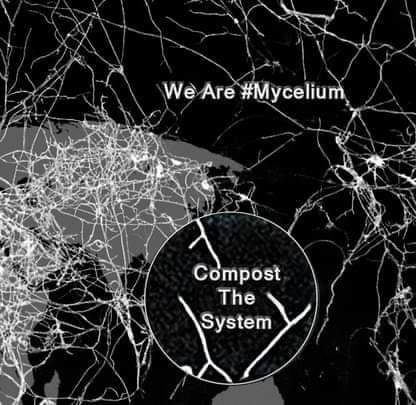
OK, despite all the #mainstreaming mess, the digital commons are still the most viable path we have, we need to see this path not as hypothetical – more as it just works, but is underresourced. From a #OMN perspective, the digital commons are not only infrastructure, it’s the soil. You don’t build movements on platforms, you grow them in commons, but this growth needs care:
- Protection from capture
- Active governance
- Social grounding, not just technical process
And most importantly the commons only survives if people act as commoners. The challenge now isn’t only to explain the digital commons, it’s to defend, rebuild, and extend it. That means funding native projects, keeping governance in the hands of participants to bridge activism, development, and real-world use as a path to push back against the continuing #mainstreaming capture.
This is not about nostalgia, it’s about #KISS recognising that we already have the tools we need, then caring enough not to only exploit them. Please try and be better than the current #mainstreaming on this, thanks.