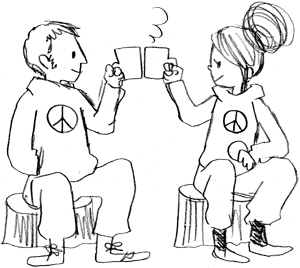
“To put some “commons” structure into this kindness… A path before we knee-jerk criticise members of the community we should make real offers to help repeatedly (x3) in a positive community way. Only then let the “negative” monster of judgment lose to clean up the mess. Focus on clean up first, the “common senses” desire to attack second. What do you think about growing our positive norms (common sense).”
This is the hard bit of any grassroots movement of turning stress, conflict, and exhaustion into actual commons culture instead of mutual destruction. The #openweb and the #oxfordboaters struggle are not separate things, they are the same social problem playing out in different spaces.
What kills communities is rarely only outside pressure. Most often, communities collapse because fear, exhaustion, and insecurity get turned inward. People stop seeing each other as comrades surviving a mess together and start judging each other as obstacles, annoyances, or moral failures.
That path always ends the same way, more, silence, resentment, burnout, fragmentation, and finally removal by outside power. If we don’t make the effort to really/affectively care the mainstream system does not need to crush fragmented communities, it just waits for them to exhaust themselves.
So it should be obverse to us that we need to consciously grow a different “common sense”, a simple common’s principles. An example that lead to this post – Before criticism, make real offers of help. Repeatedly. Publicly. Patiently. Say “Can we help?”, “Can we clean this together?”, “Can we support this person?”, “Can we solve the practical issue first?” Do this once, then again, then again. Only after repeated good-faith attempts fail do we move to much harder, but needed, conversations about responsibility and boundaries.
That flips the current social norm on its head as right now, many people instinctively jump first to blame, moral judgment, public criticism, personal conflict, and social positioning. Which only goes to make more mess with defensive reactions, gossip, claques, leading to more bad feelings and more mess to compost. The original problem becomes secondary to the social fallout, it is the same destructive pattern we see constantly on the #closedweb of people performing morality instead of building trust.
The irony is that many people involved genuinely care. The problem is the social structure they are acting inside. Without commons culture, care easily mutates into aggression under stress. And the stress is real, boat communities are under pressure:
- housing pressure,
- enforcement pressure,
- media pressure,
- financial pressure,
- environmental pressure,
- and constant uncertainty.
Under those conditions, fear spreads quickly, fear then sharpens into suspicion, suspicion turns personal. Then people who are already vulnerable get isolated and targeted. This is why community structure matters. And yes, people HATE talking about structure. Because structure sounds formal, controlling, bureaucratic, or “political”. But avoiding structure does not create freedom, it creates invisible power, unspoken hierarchies, emotional manipulation, and endless circular conflict.
#KISS applies here, keep it simple, by helping first, focus on solutions before judgment, clean up mess before assigning blame, defend community before performing outrage. That does not mean “anything goes”. Commons culture still needs boundaries. But boundaries work far better when they emerge from visible care and collective trust rather than instant punishment culture.
The really uncomfortable truth is in struggling movements, powerless people can sometimes become dangerous to the very people trying to help them. Not because they are evil, but because abandonment, stress, and insecurity distort behaviour. People lash out sideways when they have no power upwards. This is common across activist scenes, precarious housing struggles, and grassroots communities.
Meanwhile, institutions simply wait, then, when the land becomes valuable enough or politically convenient enough, they sweep everyone away. This is exactly why commons defence matters. If we are serious about defending moorings, boat culture, and free community space, then we need social solidarity strong enough to survive internal conflict without collapsing into backstabbing and fragmentation.
That means both “fluffy” and “spiky” people matter, the fluffy crew mediate, support, de-escalate, organise care and hold social trust together. The spiky crew hold boundaries, confront institutions, resist manipulation, refuse displacement to defend space when pressure grows. Without fluffy people, movements become cruel, without spiky people, movements get crushed. We need both, and despite all the mess, there are positive signs.
The growing “shiny summer” feeling among boaters matters. Community meals, litter picks, conversations, mutual support, visible presence on the river – these things are not trivial. They build legitimacy, morale, and collective identity.
That social light is important because a media dark shadow is coming, as pressure increases, traditional media narratives will frame boaters as irresponsible, antisocial, dirty, chaotic, or obstacles to “proper management”. We need to pre-counter that now through visible commons culture: care for the river, care for each other, visible participation, practical action, and stories rooted in lived history. Because this struggle is not new.
The canal system survived before because communities fought for it. The history matters. Books like Narrow Boat and struggles like Battle of Stourbridge remind us that preservation only happened because ordinary people organised collectively and refused to let living waterways be erased. This is the path again now, messy, human, imperfect, but still possible. If we can grow a new “common sense” rooted in mutual aid, patience, practical care, trust and collective defence, then free boating communities might still exist here in ten years.
Hard fight ahead, but people before us already showed that these waterways and our #openweb culture are worth defending.
#Horizontalism is a buzz word, but let’s look at it anyway as it’s the start and the end of this story, a form of social organization based on the #DIY non-hierarchical, democratic path where power is distributed among participants rather than concentrated in leaders. With a working focuses on “prefigurative politics,” to live and act in the present according to the values of the future society you want to create (e.g., equality, mutual aid, and self-management). Think of a honeycomb or network rather than a pyramid:
- Assemblies & consensus, were decision-making happens through assemblies to create affinity groups that reach working practical consensus (rather than majority voting), aiming to ensure all voices are heard.
- Affective politics is about building relationships based on dignity, trust, and mutual respect rather than mere efficiency.
- Direct action & autonomy has a long history, movements, create their own spaces and services (like food and medical care). The “Fluffy” (Constructive) aspects.
- Empowerment breaks down the “leader/follower” divide, encouraging everyone to be an active agent of change.
- Adaptability, because it is decentralized, it can be resilient and difficult for authority to “headhunt” leaders to stop it. The “Spiky” (Messy/Challenging)
Let’s look at the problems and inefficiencies: - Decision-making by only consensus is very slow and time-consuming, thus the rapid shift to #4open affinity groups to balance this.
- Hidden power dynamics is its real problem that sometimes the lack of structure leads to informal hierarchies, where those with more time or charisma dominate, despite the lack of official titles. We have to solve this by sharing responsibility.
- Scalability – while great for small, local groups, scaling this path to large, nationwide, or international movements create coordination issues that we need working federated tech projects like the #OMN for.
- Sustainability, maintaining the energy required for horizontal assembly, especially when faced with external opposition, can be difficult. But without this path of #Horizontalism as a necessary “corrective” to traditional vertical politics, we don’t and up in any participatory spaces at all.
So on a positive sense it’s an easy – but strongly anti-common sense path – to start the real composting we need. On a negative sense its mess and more mess to wade through, alongside the mainstreaming mess flooding in… it’s all mess might as well get used to this 😉