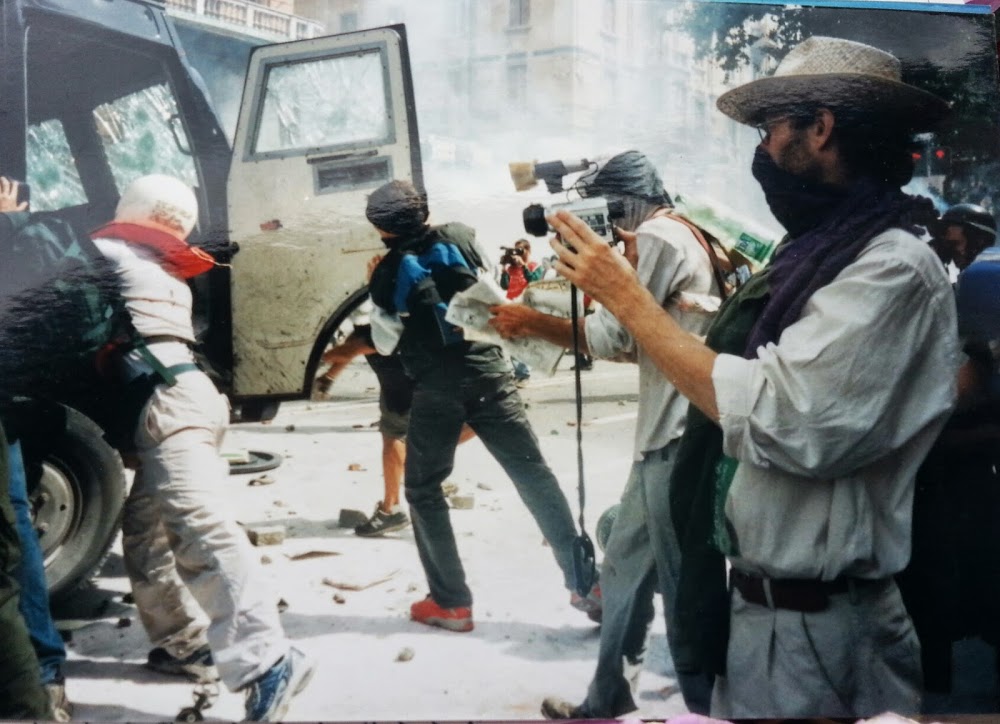
The Genoa G8 Summit protests, held from July 18 to 22, 2001, were a turning point in the global justice movement. More than 200,000 people converged on the medieval port city to block the summit and challenge the concentrated power of the world’s richest nations. A gathering of the priests of the #deathcult, grinding the planet into dust for profit.
For many of us, the G8 represented everything wrong with the world: an unelected body shaping economic and social policy for billions without legitimacy, accountability, or consent. We traveled to Genoa not as isolated activists but as a flowing living ecosystem of movements, anarchists, trade unionists, farmers, climate campaigners, media collectives, migrants’ rights groups, students, pacifists, the lot. We were there to resist and to build alternatives in the cracks protest pushes wider.
Arriving in a besieged city, Genoa a few days before the demonstrations to help set up the Media Center, for grassroots reporting. Genoa, though, felt nothing like a holiday town. Police were everywhere. Riot vans on street corners. Helicopters thudding overhead. The protest convergence center was being built on the beach; just 100 yards away from the stadium, where police forces were massing in their thousands. Walking around felt like moving inside a tightening fist.
We slept in the camper van that first night, tucked beside a half-built marquee. At dawn, we joined the organisers at the Diaz school, the building that housed both the Genoa Social Forum and the Media Centre.
We requisition two PCs from other rooms, installed video editing softwer, and turned them into the only two shared editing stations in the building. One was upgraded with a new hard drive and FireWire card for DV footage, not that it mattered, because it broke on day two and never recovered. The analogue capture system we had brought did most of the work that went online.
On one of our first reporting trips, filming outside the police barracks beside the convergence centre, we were detained by undercover cops. More arrived. Then more. Ten or twelve by the end. They demanded our tapes. I refused. They checked our documents, questioned us for hours, and released us without charge. I secretly filmed some of them; two would resurface later outside the IMC on the night of the raid.
Driving around the city to document the expanding “red zone” – the militarised area blocking off the summit – we were detained twice more. Civil rights meant nothing here. The police behaved like a sovereign power unto themselves. That Orwellian twinge – the sense that you are inside a lawless machine – grew stronger every day.
When the city turned red, one protester, Carlo Giuliani, was shot dead by police. Fear rippled across the city. The #IMC became a space threaded with arguments about what to do. People drifted away, hour by hour, some deciding the risks were too great. By midnight the centre had half emptied.
Then the screams came: “THE POLICE ARE COMING!”
Looking out the window, I saw nothing at first. Panic surged anyway, people barricading doors, grabbing bags, racing up staircases. Marion moved the archive tapes to the hiding place I’d scouted earlier: the water tower on the roof.
From the rooftop I filmed carabinieri smashing into the building next door, the Diaz Pertini school, with vans and sledgehammers. Chairs were used to break windows. Tables became battering rams. It was happening fast, shockingly fast. Then I saw them entering our stairwell.
The Diaz Raid: Running for our lives. I headed downstairs to check if the Media Center itself was being stormed. Turning the stairwell corner, I came face-to-face with a fully armoured carabiniere charging upward, truncheon raised, panting with adrenaline. I spun and bolted. Two flights up, shouting, “They’re in the building!” I sprinted to the roof and slipped into the tower.
Inside the darkness, I whispered for Marion. No answer. I crept through the corridor of water tanks, lit only by the IR beam from my camera. Finally, a small, terrified voice: “Turn the light off.” She had hidden behind the last tank, clutching tapes and equipment.
For hours, three, maybe four, we lay silent as the helicopter’s spotlight swept the windows. Police boots thudded across the roof. Below us, the city echoed with screams, crashes, and the chanted word “ASSASSINI.”
When the helicopter finally left, we emerged. The rooftop was scattered with stunned survivors. Downstairs, the destruction was total. Computers smashed. Hard drives ripped out. Doors hanging loose. The walls of the Diaz school across the street were painted with blood. Skin and hair stuck to corners. Piles of clothing soaked red. People moving like ghosts.
The Carabinieri had left their calling card.
What happened inside that school, was not policing. It was torture, humiliation, and fascist ritual. Ninety-three sleeping demonstrators were beaten so badly that the floors resembled a slaughterhouse. People hiding under tables or sleeping in bags were clubbed unconscious. A 65-year-old woman’s arm was broken. One student needed surgery for brain bleeding. Others had their teeth kicked out. One officer cut clumps of hair from victims as trophies.
Those who survived were taken to Bolzaneto detention centre, where the abuse continued: beatings, stress positions, pepper spray, threats of rape, and forced chants of “Viva il Duce!” and “Viva Pinochet!” A systematic, organised brutality. This wasn’t loss of control, it was ideology.
Aftermath: Truth in the Ruins. The Italian state tried to bury it all. But survivors, lawyers, journalists, and prosecutors fought for years. The European Court of Human Rights eventually ruled that Italy had committed grave human rights violations. But almost none of the officers served jail time. Politicians escaped entirely.
The police weren’t out of control. They were following a logic, the logic of protecting elitists power against democratic dissent. The logic of the #deathcult. The logic that treats people as obstacles, not citizens. Genoa showed the world what happens when movements gain too much momentum: the mask drops.
And still, in that chaos, seeds were planted – #indymedia, #OMN, the global justice movement, the early #openweb – messy, hopeful, compost for future uprisings.