We have already done a five-year voyage across 13 countries, travelling from the North Sea to the Black Sea, crossing the European continent through its extraordinary network of rivers, canals and inland waterways.
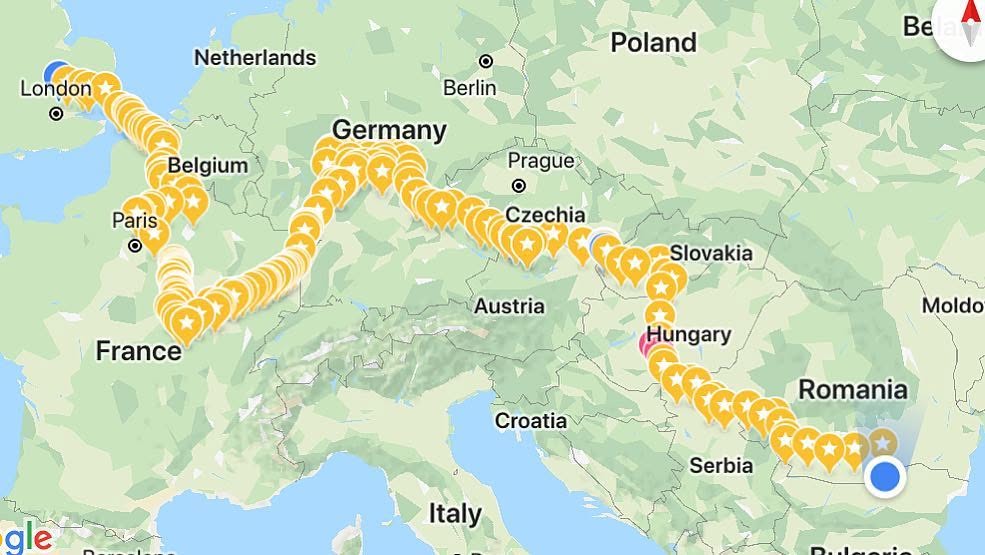
It was a slow way of travelling, that was the point. Rather than flying over Europe or rushing from one destination to another, we travelled through it, along the waterways that have connected communities, cities and cultures for centuries.
We lived on the boat, moving with the seasons and the water flows. Rivers became roads, canals became corridors, and the landscape changed gradually rather than flashing past a train or aeroplane window.
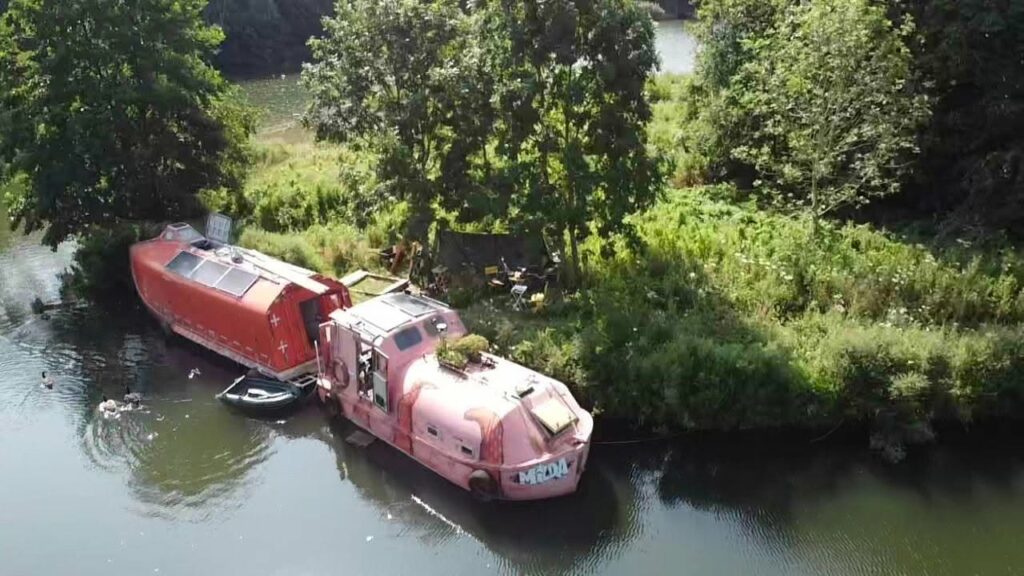
After finally arriving back in the UK, we decided that one adventure wasn’t enough. Last year we bought a bigger lifeboat, and are now fitting it out for the next stage of the journey. You can find out about this and support the media production on Patreon
The route we want to take is another extraordinary journey – we wanted to follow parts of the historic Volga trade route, travelling across some of the most geographically and culturally contrasting parts of Europe and Eurasia. The idea was to take the boat north through Finland, enter Russia via the Volga–Baltic Waterway, travel through the enormous network of Russian internal waterways and eventually follow the Volga south towards the Caspian Sea. From there, the plan was to cross to Iran.
On the map, it is an extraordinary journey: northern forests and lakes, huge rivers, vast inland seas, ancient trading routes and an entirely different cultural landscape. It is the kind of journey that makes living on a boat interesting. You aren’t simply visiting places, you are following the physical geography of a continent – moving through the infrastructure that people have used to connect themselves for centuries.
Unfortunately, geopolitics has a habit of getting in the way of geography, and right now, this particular route is not realistic. The Russian inland waterways, canals and the Volga are controlled environments. The wider Volga and Caspian region has become strategically important because of the war in Ukraine and the increasingly close logistical relationship between Russia and Iran.
Long-range drone warfare has extended far beyond the immediate front lines, with attacks affecting infrastructure deep inside Russia. The Caspian has become an important transport and logistics corridor, while sanctions, military restrictions, security concerns and rapidly changing regional politics make the idea of taking a privately operated foreign vessel through the area complicated.
There is also the much simpler problem of bureaucracy. A route that looks possible on a map can become impossible once you start asking about permissions, borders, navigation restrictions, insurance, visas, maritime regulations and access for a foreign private vessel. So for now, that plan has to go back on the shelf.
That is frustrating, but the thing you learn from living on a boat is that you don’t control the journey. You work with the weather, the water levels, the locks, mechanical problems, bureaucracy and whatever else gets thrown at you. Geopolitics is simply another, rather larger, version of the same problem.
So what do we do now? The boat is almost ready for sea trials.
We have several possibilities, one is to head north.
Scandinavia offers the kind of wilderness that makes a boat-based life worthwhile: long stretches of water, Nordic silence, enormous pine forests, lakes and archipelagos. We could travel through Sweden using the Göta Canal, then work our way into the complex waterways and islands and inland lakes of Finland. That would be a very different voyage from our previous journey.
And there is another attraction to this route, if, in a few years, the political situation changes sufficiently for Russia to become accessible again, we would already be in the right part of Europe to reconsider the original plan.
The alternative is almost the opposite, head south. Follow the rivers and canals of France, eventually reaching the Mediterranean. That would be an easier life in many ways. Warmer weather, established waterways, lots of places to stop, repair facilities, food and wine, and an enormous network of canals and rivers connecting the interior to the coast.
But even that supposedly simple option isn’t really simple anymore. Brexit has changed the practical relationship between Britain and continental Europe. Climate change is affecting waterways, droughts and flooding. And the Mediterranean itself is one of the major frontiers of a rapidly changing Europe, with increasing migration driven by war, poverty, political instability and #climatechaos.
So there isn’t really an escape route, you can move north, south, east or west, but the wider world comes with you.
Life on a lifeboat is perhaps the more interesting story, but yes, a lifeboat is an odd home. It was designed for emergencies, for getting people away from a sinking ship and keeping them alive until they reach somewhere safer.
We have turned ours into something else, a small, floating home and a platform for exploring a changing continent. There is something increasingly appropriate about that. We live in a time when the old assumptions about stability are becoming less reliable. #Climatechaos, geopolitical conflict, economic instability, Brexit and the continuing concentration of political and economic power are all changing the landscape around us.
The value in this down scaling is that boat life teaches a different way of thinking, you carry what you need. You repair things rather than automatically replacing them, generate most of your own power to learn to live with constraints. You pay attention to weather, water, infrastructure and the people around you, to accept that plans are temporary.
The important thing is not necessarily to reach the destination you originally imagined, it is to remain capable of moving when the conditions change.
So perhaps the next voyage will be Scandinavia.
Perhaps it will be France and the Mediterranean.
Perhaps, several years from now, the Volga route will become possible again.
Or perhaps something completely unexpected will happen, and we will end up somewhere we haven’t even thought about yet. That is part of the attraction, the boat is almost ready, the sea trials are coming in the spring. The next adventure will begin from there.
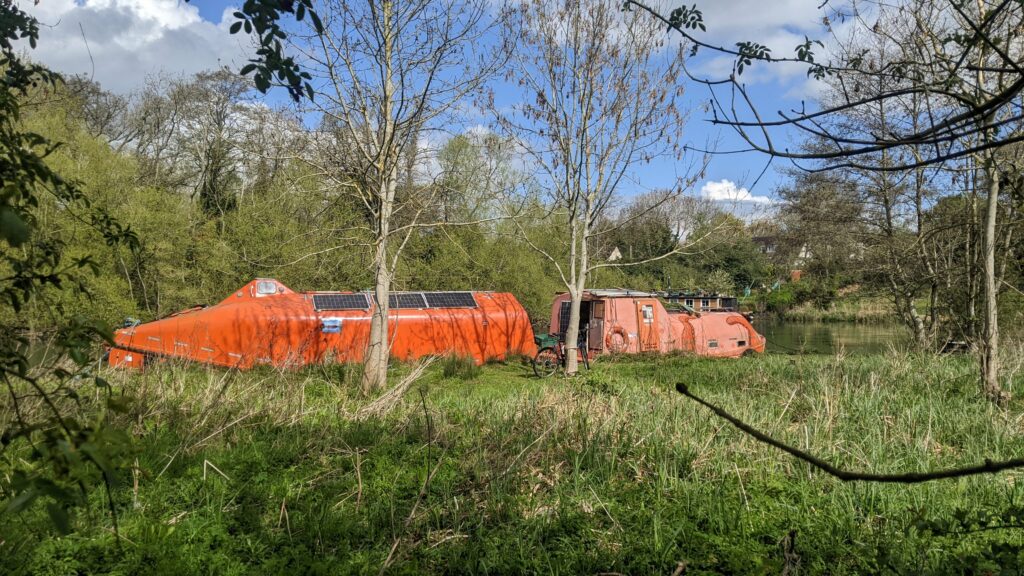
Life on a lifeboat.
#boatingeurope #lifeboat#inlandwaterways #canals #rivers #Europe