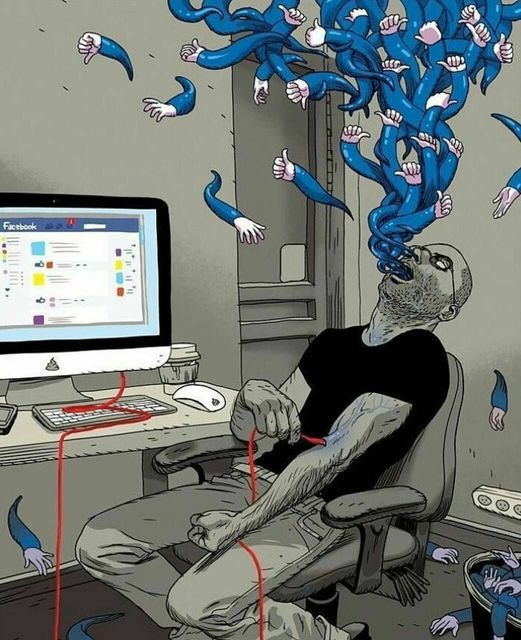
The problem of #dotcons is attention capture, its why #digitaldetox is a part of the #OMN toolbox. So lets look at why we need to act on the digital drug problem. The everyday digital drug fix starts with a notification, you pick up your phone because you get a notification. You unlock it, check the notification. Then maybe you look at one thing, then another, then another and suddenly an hour have disappeared.
You didn’t decide to spend the next hour staring at short videos selected by a #dotcons in the service of the #nastyfew. You didn’t sit down and make a conscious choice to enter the endless scroll, you just responded to a notification. Swipe – maybe this one is rubbish – swipe – that’s funny – swipe – boring – swipe – interesting – swipe – somebody attractive, and on it goes. This is the basic addiction of the #dotcons: turning our attention into a reaction rather than a choice. The important thing isn’t that one particular video is good or bad, the problem is loss of focus.
Every notification creates another injection, every swipe gives the algorithm a signal about what keeps you looking. The drug learns what holds you there, while you gradually lose track of why you picked up the phone in the first place. This isn’t communication in any real way, it’s an attention stealing machine and the more time we spend looking at it, the more normal the behaviour becomes. This is why #DigitalDetox project isn’t about telling people to “use their phones less”, its an AA meeting, we need to understand the drug is difficult to stop.
The phone isn’t the problem – digitaldetox is about #KISS technology to help people have more focus to participate in their communities. This mess we need to composting is social, the technology is a part, and yes the is piles of #techshit but under this surface is blinded ideology – the business model and the social architecture we think of as common sense.
The question is what infrastructure we build around those addictive behaviours, it is the problem with #mainstreaming, that it rarely looks like control from the inside the trap, it looks like common sense. People are presented with acceptable ideas, organizations, technologies and ways of working. Then, because everybody around them makings the same choices, those choices are “natural” – “This is just how things are done.”
But that “common sense” has a history. – for forty years, a mixture of #neoliberalism, #postmodernism, professionalisation and institutional culture has created a particular political and technological environment, that tells us that change should happen through recognized organizations, recognized experts, recognized funding structures and recognized channels.
Alternative paths are not forbidden, they are simply made difficult to see, and when people have spent decades inside this environment, asking them to look outside it can produce strong negative reaction. Then the problem is not simply bad people, it is tempting to describe this as a problem of individual personalities. Someone is arrogant, someone is ideological, someone is a gatekeeper, someone is “woke”, someone is a bureaucrat. But that misses the deeper problem, that people are shaped by the systems they live inside.
If your professional environment rewards certain ideas and punishes others, eventually you learn what can safely be said, learn which projects look fundable, learn which language gets accepted. You learn which organizations are considered legitimate. You also learn which people are worth listening to, its a #KISS social filter. The result is not only a conspiracy, it is something mundane and, more difficult to challenge, a culture reproducing itself. The people keep selecting things that make sense in the current #mainstreaming paths, and become evidence that the current #techshit mess is right all along.
This is one of the traps of #mainstreaming – its the grassroots problem we need to compost – grassroots projects come from somewhere completely different, they are messy, experimental and don’t always have professional language. They are built by people who see a #DIY problem and start doing something about it. That is where interesting alternatives begin, when these projects enter the mainstream funding and organizational environment, something bad happens. The project is asked to translate itself, then translate itself again to fit into a recognized category, demonstrate impact, scalability, governance, sustainability etc.
Then comes the compleat #block, it has to demonstrate that it already looks like something the funder understands, by the end, the thing being funded is very different from the thing that originally mattered. This fuck-up is not always malicious, it’s a structural problem of mainstreaming trying to make the unfamiliar familiar, and in doing so, it removes the qualities that made the grassroots project interesting in the first place. When we try and compost this #mainstreaming mess, people become defensive. When you challenge somebody’s “common sense”, you are not challenging an opinion, you may end up challenging their social position, their professional identity and their understanding of how the world works. That feels threatening, so its normal that the response is defensive.
Instead of asking “Could this alternative actually work?” the conversation becomes “Why aren’t you doing this properly?” Then comes the familiar #blocking “Use the proper channels.”“Talk to the right people.” “Get the stakeholders together.” “Build consensus.” “Follow the process.” “That’s not how things work.” And sometimes these are perfectly reasonable suggestions, but sometimes “proper process” is simply #blocking, ensuring that nothing outside the existing system can ever become legitimate.

The #OMN is built from a different starting point, it does not share any assumption that the existing institutions can solve the problems. It starts with people, communities, media and flows to build useful things the people can use, avoiding technical complexity to make participation is possible. We need these native technology’s as tech has its own version of the problem, the #geekproblem that assumes, if something is technically possible, the technical architecture should determine how people behave. This is the way power accumulates around administrators, developers, institutions and large communities, it is social. Thus, simply making something “open source” does not automatically make it socially open.
It is why #4opens matters, open data, open source, open standards and open processes are not the whole answer, but they can create space for communities to make their answers. Mediation rather than control, the answer to messy human behaviour is not more control. The #OMN is closer to a river than a filing cabinet, objects flow, people contribute to the flow, communities filter and shape the flow. Different places can create different views of the same underlying information. Some things become trusted – some things remain uncertain. Some things disappear from a particular view without pretending that they have magically ceased to exist everywhere.
This is a very different idea of network governance, its organic, its about composting the mess. The #openweb has accumulated decades of corporate platforms, closed APIs, surveillance economics, status games, technological churn, institutional habits and ideological baggage. There is a huge pile of shit, the answer is not to pretend otherwise, we compost it, take what is useful, break down what is harmful. Reuse existing tools, keep the lessons, discard the assumptions to help grow something new from what remains.
That is a more practical form of radicalism than simply traditional #fashionista left declaring that everything has to be destroyed and rebuilt from zero. It is also why #KISS matters, keep it simple, make the useful thing work. The real challenge to compost is cultural, the barrier to alternative technology is often not technology it self, it is the problem of common sense imagination. People need to imagine that things could work differently, then after this grassroots paths need space to experiment, to grow, before they are forced into the current #mainstreaming.
Funders like #NLnet need to recognize that something can be valuable before it has already become institutionally respectable. And #mainstreaming organizations need to understand that they are not the source of innovation, as to often they are the last people to notice this, that does not mean abandoning them, but it means not making them the only path.
So the question becomes, how can we convince them to build real alternatives, we can just to spend another twenty years trying to convince a closed system that it should become open. The path out of this mess is simple build something open, don’t waist to much time and focus explaining to institutions why grassroots communities deserve infrastructure. And don’t wait for “the right people” to give permission, start with the people who are already doing the work.
The important shift is from permission to participation, from ownership to commons, from control to mediation, from platforms to flows. From mainstreaming the grassroots into existing institutions to letting grassroots practice grow outward into the wider culture. The existing “common sense” can be composted, it is not inevitable, it is simply what has grown around us, to become a mess. We don’t have to worship the mess, we can pick up a shovel, turn the pile, let it breathe and grow something better from it.